Estimated reading time:
Wood selection for acoustic guitars should not stop at experiential judgments like “this wood sounds good.” Nor does the price of a wood show any engineering-level correlation with acoustic performance — it is driven by scarcity and market supply and demand. A more accurate understanding is: different parts of the guitar serve different functions, and therefore require different material parameters.
The soundboard must efficiently convert string energy into airborne sound; the back and sides act as an energy boundary, a reflective structure and a resonating shell; the neck is a structural member under long-term string tension; the fretboard and bridge emphasize hardness, wear resistance, stability and local energy transfer.
The core of wood selection for acoustic guitars is therefore not “expensive wood is always better,” but rather:
Using wood with matching parameters in the right position, and converting the material’s potential into a stable sonic outcome through thickness, bracing, radius, gluing and moisture control.
I. Core Parameters of Acoustic Guitar Woods
1. Density: ρ
Density is the most fundamental parameter, usually expressed in (kg/m^3).
Density affects three aspects:
- Mass
- Resonant frequency
- Energy response speed
At equal stiffness, the lower the density, the more easily the plate is driven by the strings; higher density means more inertia and slower onset, but may bring stronger reflection, sustain and a sense of stability.
For a soundboard, excessively high density is usually unfavorable, because a top needs to be “light and stiff.”
For back and sides, high density is not necessarily a drawback, since they are not mainly responsible for radiating sound directly, but act more like an energy boundary.
2. Young’s modulus: E
Young’s modulus describes a material’s ability to resist tensile or bending deformation, usually expressed in (GPa).
Wood is a strongly anisotropic material its stiffness varies greatly between directions:
- Along the grain: (EL)
- Radial direction: (ER)
- Tangential direction: (ET)
(EL) is usually far higher than (ER) and (ET).
For a guitar soundboard, stiffness along the grain is critical, because the strings apply continuous tension and dynamic excitation through the bridge. Insufficient grain-direction stiffness makes the top prone to collapse, sluggish in response and limited in dynamic ceiling.
3. Specific modulus:
The specific modulus is a key indicator for judging soundboard woods:
It expresses “how much stiffness is provided per unit of mass.”
For a soundboard, the ideal material is neither simply high stiffness nor simply low density, but:
This is the core reason why spruces have long been the mainstream soundboard material. Spruce can usually provide high grain-direction stiffness at relatively low density, and therefore offers high acoustic efficiency.
4. Speed of sound: c
In a simplified model, the speed of sound along the grain in wood can be approximated as:
where:
- (CL): speed of sound along the grain
- (EL): Young’s modulus along the grain
- (ρ): density
A high speed of sound usually means the material transmits vibrational energy faster. For a soundboard, high sound speed typically corresponds to faster response, clearer transients and higher efficiency.
5. Mechanical impedance: Z
The mechanical impedance can be approximated as:
Substituting
we obtain:
Impedance expresses how readily a material “accepts vibrational input.”
For a soundboard, excessive impedance means the string energy cannot easily drive the top; the sound may start slowly with low sensitivity.
For back and sides, a higher impedance can actually help reflect energy, making the sound more focused with more sustain.
6. Acoustic radiation coefficient: R
The acoustic radiation coefficient is often used to evaluate the acoustic efficiency of resonant materials. It can be approximated as:
Substituting the formula for the speed of sound:
For a soundboard, the ideal situation is:
that is, high stiffness, low density and high speed of sound.
7. Internal damping: η
Internal damping describes a material’s ability to convert vibrational energy into heat.
A common approximation is:
where:
- (Q): quality factor
- (η): loss factor or damping coefficient
High damping makes the sound decay faster and flattens peaks; it may feel softer, warmer and less harsh.
Low damping gives longer sustain, clearer highs and a more open dynamic range, but can also make the sound sharper or harder to control.
For a soundboard, low damping is generally desirable — but lower is not always better. Too little damping may overemphasize local peaks and make the sound uneven.

II. Wood Selection Logic for Different Parts
1. Soundboard: the goal is “light, stiff, low damping, high efficiency”
The soundboard is the main sound-producing component of an acoustic guitar. String vibration enters the top through the bridge, and the top then drives the air to create sound.
The core goals for a soundboard are:
| Parameter | Requirement |
|---|---|
| Density | Lower |
| Grain-direction modulus | Higher |
| Specific modulus | High |
| Speed of sound | High |
| Damping | Lower |
| Cross-grain stiffness | Sufficient |
| Stability | High |
| Crack risk | Low |
The basic judgment formula for a soundboard can be simplified as:
This is also why spruces have long dominated the mainstream soundboard position.
Common soundboard woods
| Wood | Typical characteristics | Best suited for |
|---|---|---|
| Sitka Spruce | Balanced, wide dynamics, versatile | All-round steel-string guitars |
| Adirondack / Red Spruce | High dynamic ceiling, resists compression under heavy strumming | Bluegrass, heavy strumming, Dreadnought |
| European Spruce | Refined, sweet, delicate highs | Fingerstyle, classical-style steel-string |
| Engelmann Spruce | Responsive to a light touch, soft voice | Fingerstyle, light-handed playing |
| Western Red Cedar | Fast onset, warm, lower dynamic ceiling | Classical, light-touch fingerstyle |
| Redwood | Cedar-like but more mature, with a stronger sense of stability | Fingerstyle, studio-oriented guitars |
Why can’t you judge a soundboard by its grain lines alone?
Even, straight, quarter-sawn grain is an important indicator, but not the whole picture, because the sonic outcome is determined by several parameters together:
where:
- (f): modal frequency of the plate
- (h): thickness
- (E): elastic modulus
- (ρ): density
Note that thickness (h) has a large effect on frequency. More completely, the bending stiffness of a plate can be approximated as:
where:
- (D): bending stiffness
- (E): Young’s modulus
- (h): thickness
- (ν): Poisson’s ratio
Thickness has a cubic effect:
This means:
for the same piece of wood, differences in thickness may change the sound more directly than differences between species.
So soundboard selection must not rely only on “species” and “grain”; it must combine density, stiffness, thickness, bracing and the target tone.
2. Back and sides: the goal is “stability, reflection, tonal coloring, boundary conditions”
The back and sides are not the main sound source, but they influence the boundary conditions of the sound, energy reflection, resonance behavior and sustain characteristics.
The tasks of the back and sides include:
- Forming the structural shell of the body
- Constraining the movement of the top
- Reflecting part of the sound energy
- Participating in low-frequency coupling
- Providing a degree of tonal coloring
The priorities for back and sides therefore differ from those of the top.
| Parameter | Requirement |
|---|---|
| Density | Medium-high density is common |
| Impedance | Can be relatively high |
| Damping | Chosen according to the target sound |
| Stability | High |
| Bending workability | Good |
| Cracking risk | Low |
| Appearance | Important |
Common back and side woods
| Wood | Typical sonic tendency | Main reason |
|---|---|---|
| East Indian Rosewood | Deep lows, rich overtones, long sustain | High density, low damping, strong reflection |
| Brazilian Rosewood | Rich overtones, deep lows, high complexity | High density, high acoustic impedance, historical scarcity |
| Mahogany | Prominent mids, direct sound, fewer overtones | Medium density, relatively higher damping |
| Maple | Bright, clear, fast reflection, controlled overtones | High density, little tonal coloring |
| Walnut | Between mahogany and rosewood | Medium density, well balanced |
| Koa | Sweet mids, strong visual appeal | Medium-high density, large individual variation |
| Sapele | Mahogany-like but harder and brighter | Stable, good availability |
The relationship between back/sides and top
An acoustic guitar can be simplified into a coupled system:
The top handles the main energy conversion; the back and sides influence how energy is retained, reflected and dissipated.
If the back and sides have low damping and high density, the sound may have more sustain and complex overtones.
If their damping is higher, the sound may be more direct, clean and recording-friendly.
This is why rosewood is often described as “complex, rich in overtones, deep in the lows,” while mahogany is often described as “direct, mid-forward, clean.”
3. Neck: the goal is “bend-resistant, torsion-resistant, long-term stable”
The neck is not a main sounding plate, but a structural member that bears string tension over the long term.
The total string tension of a steel-string acoustic guitar typically reaches tens of kilograms. The neck must resist over the long term:
- Tension along the strings
- Bending deformation
- Torsional deformation
- Humidity changes
- Creep
- Glue-joint stress between fretboard and neck
Key indicators for neck materials:
| Parameter | Requirement |
|---|---|
| Grain-direction stiffness (EL) | High |
| Shear modulus (G) | High |
| Density | Should not be too high |
| Stability | Very high |
| Shrinkage rate | Low |
| Torsional resistance | High |
| Workability | Good |
Bending resistance correlates strongly with material stiffness and section depth. In a simplified beam model, the bending stiffness is:
where:
- (E): Young’s modulus of the material
- (I): second moment of area of the section
For a rectangular cross-section:
where:
- (b): width
- (h): thickness or height
This shows that a neck’s bending resistance depends not only on the wood, but strongly on the neck’s cross-section design.
Common neck woods
| Wood | Characteristics | Suitability |
|---|---|---|
| Mahogany | Moderate weight, stable, good workability | The most classic acoustic guitar neck material |
| Spanish Cedar | Lighter, often used on classical guitars | Suitable for weight reduction, but lower stiffness |
| Maple | High stiffness, hard, stable | Suitable for designs needing brightness and high stability |
| Walnut | Stable, medium weight | Can serve as an alternative neck material |
| Sapele | Mahogany-like, slightly higher density | Good cost and availability |
Neck selection should not chase lightness alone. A neck that is too light but insufficiently stiff leads to long-term action changes, fret buzz, twisting and drifting feel.
A more reasonable goal is:
that is, sufficient bending and torsional resistance per unit of weight.
4. Fretboard: the goal is “hard, wear-resistant, stable”
The fretboard directly endures long-term friction and local pressure from fingers, frets and strings. Its acoustic influence exists, but durability and stability take priority.
Key considerations for fretboard materials:
| Parameter | Requirement |
|---|---|
| Janka hardness | High |
| Density | High |
| Wear resistance | High |
| Dimensional stability | High |
| Shear stiffness (G) | High |
| Gluing reliability | Good |
| Surface feel | Good |
Common fretboard materials:
| Wood | Characteristics |
|---|---|
| Ebony | High density, high hardness, fine touch, premium look |
| Rosewood | Slightly softer, oily, warm mids |
| African Blackwood | Extremely high density and hardness, strong torsional resistance |
| Pau Ferro | Common rosewood substitute |
| Maple | Bright, hard, needs surface finish protection |
The fretboard’s influence on sound is more like “boundary refinement” than a core sound source. It may alter the attack, clarity and local damping, but it does not define the instrument’s main acoustic character the way the top does.
5. Bridge: a small part with a big influence
Although small, the bridge sits at the energy input point — the key component through which string vibration enters the top.
The bridge’s core functions:
- Transferring string energy
- Providing local mass
- Changing the top’s stiffness around the bridge
- Affecting high-frequency response
- Affecting onset speed
A too-heavy bridge reduces the top’s sensitivity:
where:
- (f): system resonant frequency
- (k): equivalent stiffness
- (m): equivalent mass
When the bridge mass (m) increases, the resonant frequency drops, the response may slow down and the highs may decrease.
Bridge materials therefore usually need:
| Parameter | Requirement |
|---|---|
| Hardness | High |
| Density | Medium-high, but not too heavy |
| Gluing performance | Good |
| Stability | High |
| Crack resistance | Good |
Common materials include rosewood, ebony and African blackwood. Ebony is harder and heavier; rosewood is relatively lighter with different damping characteristics. The final choice must combine top thickness, bracing and target response.
III. How Wood Parameters Affect Sound
Wood parameters mostly shape the tone through modal behavior. For more detail, see the related articles here and here (or click the card links below).
This article does not go deep into modal theory; it keeps more natural language so that more readers can follow and understand.
1. Response speed
Response speed mainly relates to the top’s mass, stiffness and damping.
Roughly speaking:
Soundboards with low density, high specific modulus and low damping are usually easier to excite with a light touch.
This is why Engelmann spruce and Western red cedar are often considered responsive to a light touch, while Adirondack spruce needs stronger excitation to fully open up, in exchange for a higher dynamic ceiling.
2. Dynamic ceiling
The dynamic ceiling can be understood as: as playing force increases, can the sound stay clear, stable and uncompressed?
A high dynamic ceiling usually requires:
Adirondack spruce is often used for high-dynamics playing because its stiffness and strength perform well, and it does not compress too early under heavy strumming.
Cedar tops respond quickly to a light touch, but under strong force they compress more easily and lose definition.
3. Sustain
Sustain relates to the system’s energy loss.
In simplified terms:
Low damping means slow energy decay and longer sustain.
High damping consumes energy faster; the sound is shorter and cleaner.
Rosewood back and sides are often credited with longer sustain, partly due to their high density, low damping and strong reflection. Mahogany is often considered more direct and drier because of its different energy feedback and damping characteristics.
4. High-frequency brightness
High-frequency behavior relates to multiple factors:
- Soundboard stiffness
- Bridge mass
- Soundboard damping
- Finish-film damping
- Back-and-sides reflection
- Local boundary conditions of neck and fretboard
Low-damping materials preserve high-frequency detail more easily:
But too many highs do not equal a good sound. If certain modal peaks are too strong, the result can be harsh, thin and piercing. Good design is not simply chasing “brightness,” but controlling spectral balance.
5. Tonal complexity
Tonal complexity usually comes from the coupling between multiple modes:
Rosewood back and sides often bring richer overtones; mahogany and maple can make the sound more focused and direct.
Complexity is not an absolute advantage. In recording, sing-along and ensemble contexts, too many overtones may occupy spectral space; in solo and fingerstyle contexts, rich overtones may enhance expressiveness.
IV. Common Wood Combinations and Use Cases
| Top + back/sides | Sonic tendency | Typical use |
|---|---|---|
| Sitka spruce + East Indian rosewood | Balanced, deep lows, rich overtones | All-round, recording, solo |
| Sitka spruce + mahogany | Direct, strong mids, clean sound | Sing-along, recording, folk |
| Sitka spruce + maple | Bright, clear, controlled overtones | Live, ensemble, strumming |
| Adirondack spruce + rosewood | Wide dynamics, strong projection, rich overtones | Bluegrass, heavy strumming, Dreadnought |
| Adirondack spruce + mahogany | Strong punch, firm attack | country、flatpicking |
| Engelmann spruce + rosewood | Sensitive to light touch, refined, rich overtones | Fingerstyle, solo |
| European spruce + rosewood | Sweet, refined, strong classical character | Classical-style steel-string, solo |
| Cedar + mahogany | Warm, intimate, prominent mids | Light-touch fingerstyle, sing-along |
| Cedar + rosewood | Lush, soft, rich overtones | Classical, fingerstyle |
| Redwood + walnut | Warm, balanced, recording-friendly | Fingerstyle, recording |
V. Wood Selection Process in Guitar Making
1. Soundboard screening
Grading tops by visual inspection alone is not recommended. A more reliable process is:
- Measure weight
- Measure dimensions
- Calculate density
- Tap or excite to measure frequency
- Measure deflection
- Judge grain-direction and cross-grain stiffness
- Check grain, knots, cracks and runout
- Decide thickness and bracing strategy according to the target model
Top grading should serve concrete product goals.
Heavy-strumming guitars and light-touch fingerstyle guitars should not use exactly the same grading logic.
2. Back and sides screening
For back and sides, focus on:
- Stability
- Crack risk
- Bending workability
- Density
- Damping tendency
- Visual grade
- Sustainability and compliance
For back and sides, harder is not necessarily better, and heavier is not necessarily better. For mass production, stability and processing yield matter a lot.
3. Neck screening
Neck grading should lean more structural:
Key checks:
- Whether the grain is straight
- Whether there is obvious sloping grain
- Whether there is warping risk
- Whether there is internal stress
- Whether it is fully dried
- Whether it suits lamination or carbon-fiber reinforcement
- Whether it stays stable after humidity cycling
For the neck, sonic gains must yield to structural reliability. After-sales problems from neck deformation far outweigh gains from tiny tonal differences.
VI. Moisture Content and Stability
Wood parameters must be discussed at a specific moisture content. At different moisture levels, density, stiffness, damping and dimensions all change.
The equilibrium moisture content (EMC) of wood is determined by ambient temperature and humidity. A common goal in guitar making is to let the wood stabilize under conditions close to its usage environment.
If workshop humidity control is unstable, the result can be:
- Soundboard cracking
- Back and sides shrinking
- Neck deformation
- Fretboard shrinkage causing fret sprout
- Increased bridge gluing risk
- Seasonal action changes
Wood selection must therefore be considered together with humidity management.
Empirically, acoustic guitar production environments should usually be kept within a relatively stable temperature and humidity range. For example:
| Item | Recommendation |
|---|---|
| Relative humidity RH | Around 40%–50% |
| Temperature | Stability first |
| Wood intake | Record batch, weight, moisture content |
| Before machining | Fully condition (acclimatize) |
| Before gluing | Avoid short-term humidity swings |
| Before shipment | Re-inspect stability |
Dimensional changes in wood are directional:
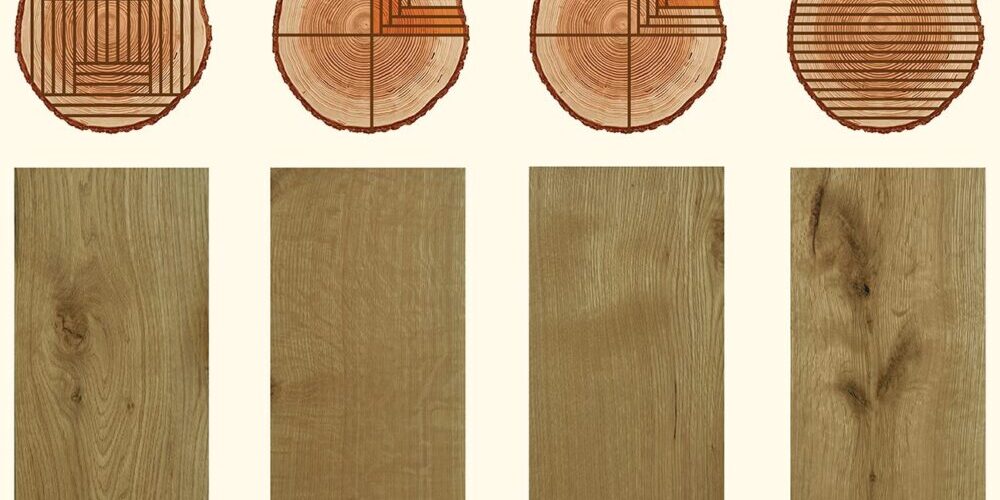
This is why tops and backs usually emphasize quarter-sawing. Quarter-sawn material is more stable across the width, straighter in grain, with lower deformation risk.
Kepma Wood Equilibrium Moisture Content (EMC) Visualization Tool
Enter temperature and relative humidity
Temperature is entered in degrees Celsius °C, relative humidity in percentages %. The horizontal axis is relative humidity RH; the vertical axis is EMC, i.e. the equilibrium moisture content based on oven-dry mass.EMC curve
The curve shows how the equilibrium moisture content of wood changes with relative humidity at a given temperature.Mathematical model: Hailwood–Horrobin equation
1. EMC main equation
Let h = RH / 100 be the decimal form of relative humidity. Then:
EMC(T, h) = (1800 / W) × [ (k × h) / (1 - k × h)
+ (k1 × k × h + 2 × k1 × k2 × k² × h²)
/ (1 + k1 × k × h + k1 × k2 × k² × h²) ]
2. Coefficients W, k, k1, k2, with T in degrees Celsius
W = 349 + 1.29 × T + 0.0135 × T²
k = 0.805 + 7.36e-4 × T - 2.73e-6 × T²
k1 = 6.27 - 9.38e-3 × T - 3.03e-4 × T²
k2 = 1.91 + 4.07e-2 × T - 2.93e-4 × T²
3. Meaning of the symbols
- EMC: Equilibrium Moisture Content, expressed in %.
- T: ambient temperature, in °C.
- RH: ambient relative humidity, in %.
- h: the decimal form of relative humidity; for example, at RH = 50%, h = 0.50.
- W, k, k1, k2: temperature-dependent empirical fitting coefficients.
- The first term: corresponds to monomolecular adsorbed water.
- The second term: corresponds to polymolecular adsorbed or dissolved water.
VII. The Principle of Heat Treatment
Heat-treated wood, often called torrefied or roasted wood, is produced by thermally treating wood in a low-oxygen environment, altering some of its volatile components and hemicellulose.
Heat treatment may bring:
- Reduced moisture sensitivity
- Improved dimensional stability
- Slightly lower density
- Possible improvement in sound speed and specific modulus
- Possibly lower damping
- Darker color
- Possibly increased brittleness
It can be simplified as:
This can be favorable for a top, as it may bring faster response and the dry character associated with an “aged” instrument.
But heat treatment is not an unconditional upgrade. Excessive heat treatment may cause:
- Increased brittleness
- Changed gluing risk
- Reduced crack resistance
- Thinner sound
- Reduced structural safety margin under high dynamics
VIII. Material Priorities for Different Parts
| Part | Acoustic performance | Stability | Strength | Weight | Workability | Appearance |
|---|---|---|---|---|---|---|
| Soundboard | Highest | High | High | High | Medium | Medium |
| Back and sides | Medium-high | High | Medium | Medium | High | High |
| Neck | Medium | Highest | Highest | High | High | Medium |
| Fretboard | Medium-low | High | High | Medium | Medium | High |
| Bridge | High | High | High | High | High | Medium |
More specifically:
- Soundboard: prioritize (E/ρ), damping, sound speed, grain stability
- Back and sides: prioritize stability, density, damping, bending workability
- Neck: prioritize bending resistance, torsional resistance, low deformation, low creep
- Fretboard: prioritize hardness, wear resistance, stability
- Bridge: prioritize hardness, mass, gluing performance, energy-transfer efficiency
IX. Common Misconceptions in Wood Selection
Misconception 1: Expensive wood always sounds better
Not true.
Expensive wood may be scarce, beautiful and steeped in tradition, but that does not mean it is necessarily better suited to a particular guitar. The sonic outcome comes from the joint action of material and structure.
Wood is only one of the input variables.
Misconception 2: Judging by species only, ignoring individual plate variation
Variation within a single species can be large. Two Sitka spruce plates may differ significantly in density, stiffness and damping.
A more reliable approach is to measure each plate individually, rather than judging by the species label.
Misconception 3: The thinner the top, the better
A thinner top increases sensitivity, but also reduces the structural safety margin.
Since bending stiffness follows:
A slight reduction in thickness noticeably reduces stiffness. An overly thin top may sound open in the short term, but over time is prone to collapse, deformation and insufficient dynamics.
Misconception 4: Back and sides must be as hard and heavy as possible
Not necessarily.
High-density back and sides can enhance reflection and sustain, but may also make the sound overly complex, too heavy in the lows, or uneven in response. Different body sizes and target tones need different back-and-side strategies.
Misconception 5: The neck wood mainly determines the tone
The neck wood does affect sound, but structural stability matters more. For mass production and after-sales, the neck's bending resistance, torsional resistance, drying and dimensional stability outweigh subtle tonal differences.
X. Practical Wood Selection Advice
1. If the goal is an all-round steel-string guitar
Recommended direction:
- Soundboard: Sitka spruce
- Back and sides: East Indian rosewood / mahogany / walnut
- Neck: mahogany or a stable alternative
- Fretboard: ebony, rosewood, pau ferro
The logic:
Sitka spruce is forgiving, with a wide dynamic range, suiting strumming, sing-along and fingerstyle. Paired with rosewood the sound is richer, with mahogany more direct, with walnut more balanced.
2. If the goal is heavy strumming, bluegrass and big dynamics
Recommended direction:
- Soundboard: Adirondack spruce
- Back and sides: rosewood or mahogany
- Body: Dreadnought or large body
- Bracing: ensure structural support and dynamic headroom
The logic:
Adirondack spruce has a high dynamic ceiling and does not compress easily under strong excitation.
3. If the goal is light-touch fingerstyle
Recommended direction:
- Soundboard: Engelmann spruce, European spruce, Western red cedar, redwood
- Back and sides: rosewood, walnut, koa
- Body: OM, GA, small jumbo, etc.
The logic:
Light-touch fingerstyle needs a low onset threshold, rich detail and good sustain. The top should not be too thick, and the bridge mass must be controlled.
4. If the goal is recording-friendliness
Recommended direction:
- Soundboard: Sitka spruce, European spruce, redwood
- Back and sides: mahogany, walnut, maple
- Control overtone complexity
The logic:
In a recording environment, too much low end and too many overtones can be hard to mix. A more direct, focused sound is easier to place into a track.
5. If the goal is stable mass production
Recommended direction:
- Soundboard: reliably supplied Sitka or European spruce, or proven alternatives
- Back and sides: mahogany-type woods, sapele, walnut, stable rosewood
- Neck: stable mahogany, sapele, maple, laminated construction
- Fretboard: sustainably supplied ebony substitutes, rosewood substitutes, engineered materials
XI. The Essence of Wood Selection Is System Matching
The essence of wood selection for acoustic guitars is not the search for some “magical wood,” but the establishment of a parameterized judgment system.
The top should be light, stiff, low-damping and efficient; the back and sides stable, reflective and tonally coloring; the neck bend-resistant, torsion-resistant and deformation-free over time; the fretboard hard, wear-resistant and stable; the bridge balanced between mass, hardness and energy transfer.
In one sentence:
The top determines how energy is excited, the back and sides determine how it is retained and shaped, the neck determines whether the system stays stable over time, and the fretboard and bridge determine the local boundary conditions and playing-feel details.
The most reliable method of wood selection in guitar making is not relying on species names and experiential adjectives, but building a data closed loop:
Only when material parameters, structural design and real testing form a closed loop does wood selection turn from empiricism into a replicable engineering capability.

Two further readings embedded in this article
The full content of two site articles is embedded in the body of this article as further reading on this topic.
The first is “Fundamentals of Guitar Modal Concepts,” which introduces the basic concepts of modes, Chladni patterns of circular plate vibration, the meaning of nodal lines and antinodes, and the relation between natural frequency, Young's modulus and density, with an interactive circular-plate mode-shape simulator.
The second is “Acoustic Modeling of the Guitar as a Coupled Vibrating System,” which discusses how the guitar is not a simple superposition of single oscillators but a coupled vibrating system of top, back and body air cavity, and covers how coupling affects frequency and response and how to handle it in modeling.
Together with this article, the two pieces form one thread: from wood selection and parameters, to the modal behavior of the top, to the acoustic response of the coupled whole instrument. Suggested order: this article, modal fundamentals, coupled modeling.


-10--scaled-e1787801713475-110x80.jpg)