Contents
Fundamentals of Guitar Modes
Basic Modal Concepts
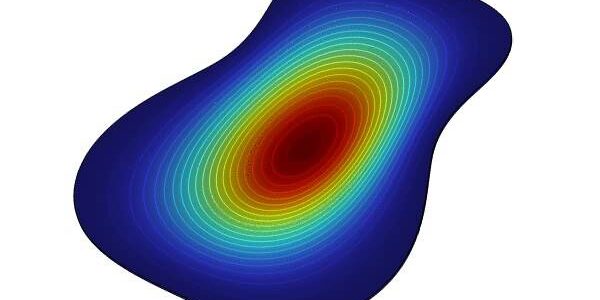
Modal Definition: Modal Analysis (Modal Analysis) is a theory and method for studying the inherent vibration characteristics of structures. It mainly includes parameters such as modal frequency, modal shape, damping ratio, modal mass, modal stiffness, and modal participation factor. For linear systems, each mode can be understood as a spatial vibration form that is most likely to occur near a certain natural frequency of the structure.
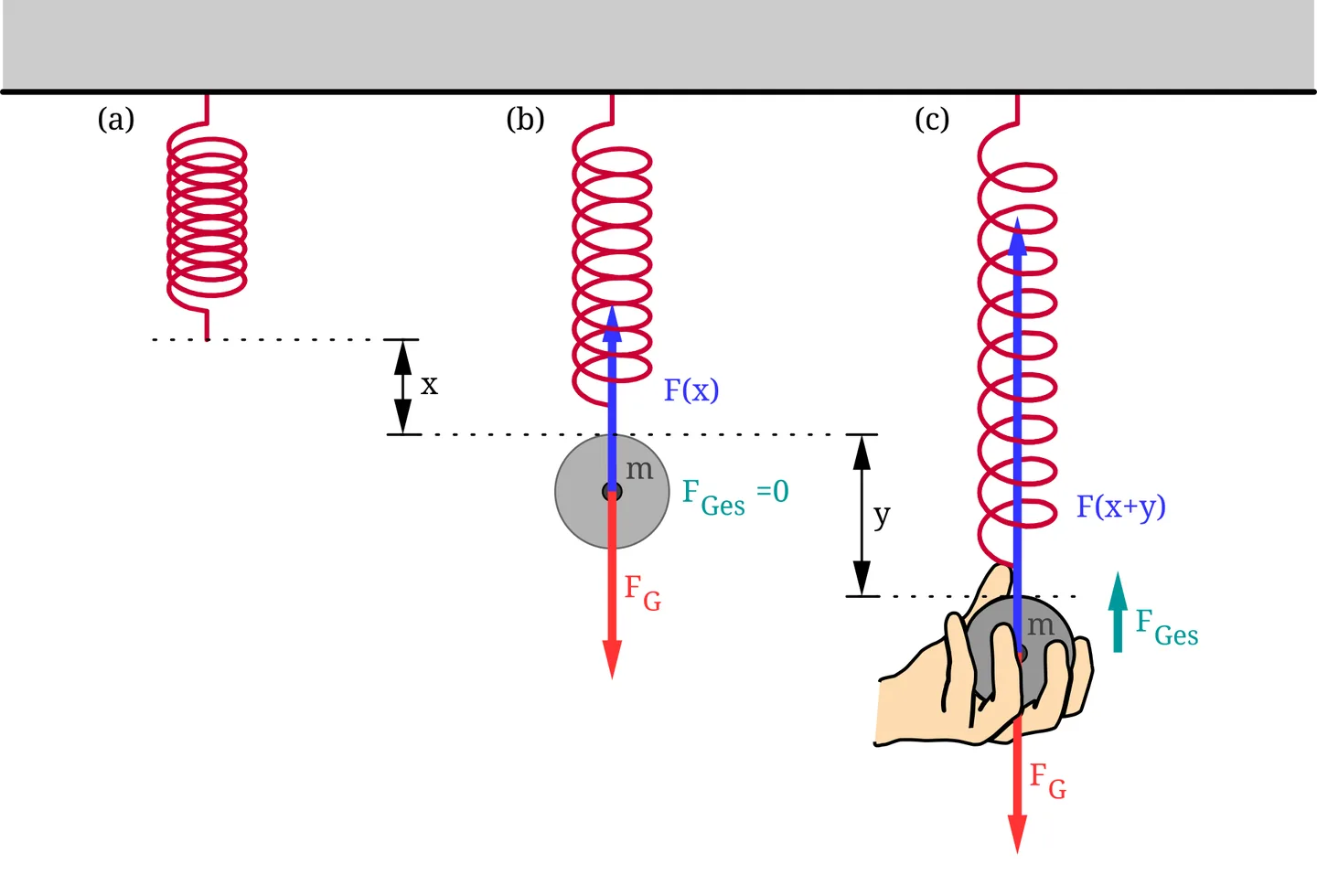
Image source:MikeRun · CC BY-SA 4.0
In the plate equation, τ is the Kelvin–Voigt time parameter in seconds, not the dimensionless loss factor η. For harmonic motion in this particular model, η(ω)=ωτ. Modal stiffness uses the full isotropic curvature-energy expression; real wood plates require anisotropy, bracing and actual boundaries. The quality-factor relation applies to a lightly damped, separable mode.
When the structure is excited near a certain modal frequency, if the excitation position and direction match the mode shape, the mode will be effectively excited. The position in the mode shape where the displacement is close to zero or the phase is reversed is called a nodal line or a node region; the region with a large displacement is called an anti-node region. The vibration of the guitar top, back, cavity air and bridge system is not a simple movement of a single frequency, but the result of the coupling of multiple structural modes and air modes. The modal frequency is mainly determined by the mass distribution, stiffness distribution, boundary conditions and coupling relationships of the system.
Equations of motion and eigenvalue issues: In a linear elastic system, undamped free vibration can be described by the following differential equation of motion (for linear, lightly damped systems, any response can be expanded into a linear superposition of modes).
Let the generalized displacement of the system be q(r,t), then
q(\mathbf r,t)=\sum_k\phi_k(\mathbf r)\eta_k(t),\quad\eta_k(t)=A_k\cos(\omega_{d,k}t+\varphi_k)e^{-\zeta_k\omega_{n,k}t},\quad\omega_{d,k}=\omega_{n,k}\sqrt{1-\zeta_k^2}Differential equation of motion of a linear elastic system (undamped free vibration):
Modal participation factor and resonance: When the frequency of external excitation coincides with a certain modal frequency, the structure will undergo resonance in this mode, resulting in a significant vibration response. However, the strength of the resonance response not only depends on the degree of frequency agreement, but also depends on the ” coupling efficiency” of the excitation to the mode. This is measured by the Modal Participation Factor: For an excitation force or displacement input in a given direction, the Modal Participation Factor is a scalar quantity indicating the degree of participation of that mode in the overall response of the structure. If the participation factor of a certain mode in this direction is large, when the excitation frequency is close to its modal frequency, the mode will be strongly excited to produce a significant response; the modal participation factor is used to describe the contribution of a certain mode to the response under a specific excitation position, excitation direction and measured quantity. Even if the excitation frequency is close to a modal frequency, the mode may be weak in the measured response if the excitation point is located near the mode node or if the excitation direction does not match the main direction of motion of the mode. On the contrary, if the excitation position and direction are highly matched to the mode shape, an obvious response may occur even if the input energy is not large. Therefore, the actual dynamic response not only depends on whether the frequency is close to the natural frequency, but also depends on the spatial matching relationship between the excitation and the mode shape.
Acoustic guitar structure and main resonance components
Acoustic guitar (including classical guitar and steel-string acoustic guitar) is a complex acoustic structure, which is composed of strings , bridge , soundboard (panel) , back plate , side panels (side walls of the body) , braces , soundhole and the air in the cavity. Each part plays a different role in the modal vibration of the guitar:
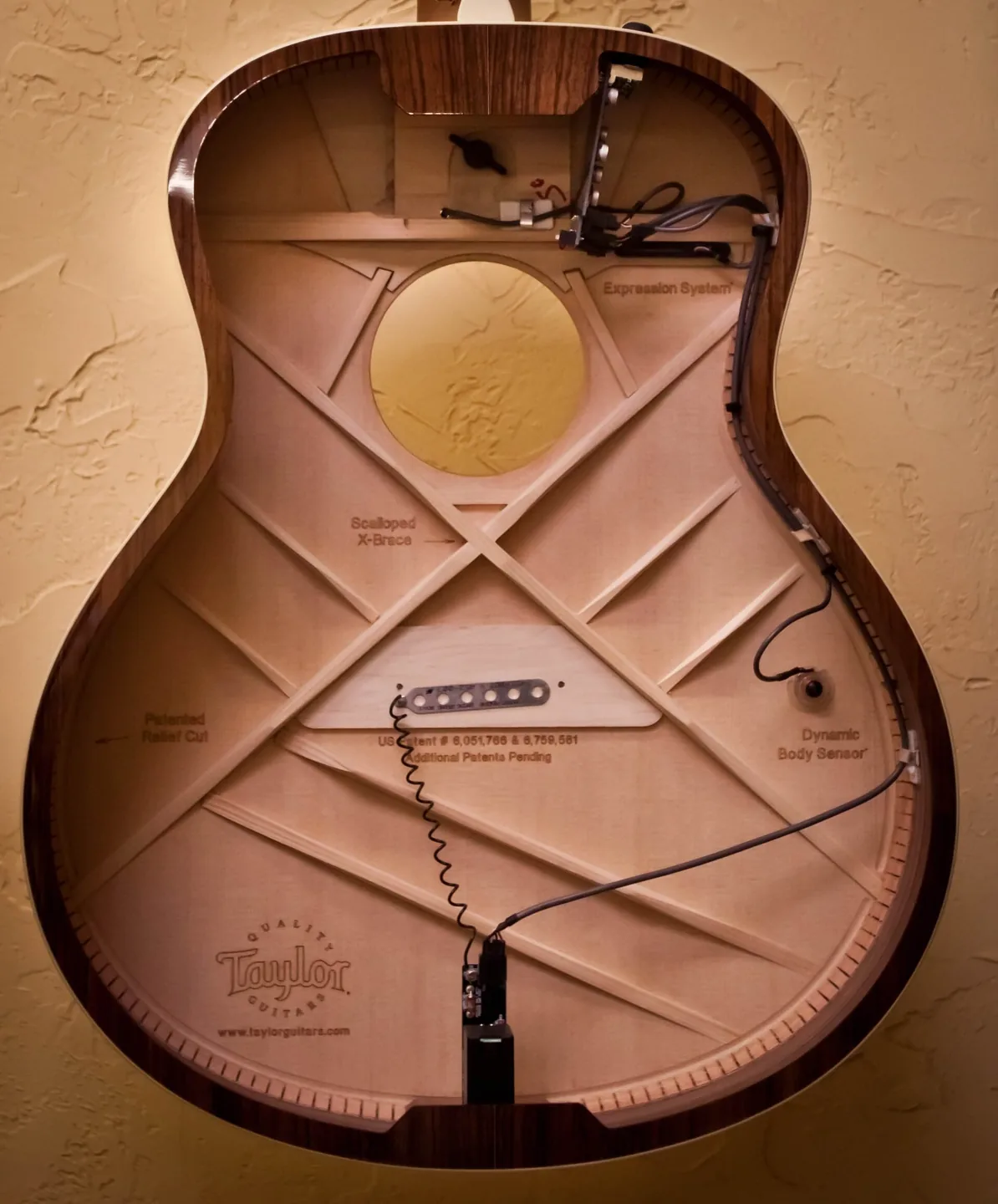
Image source:Richard · CC BY-SA 2.0
- Soundboard (panel) : The soundboard is the main structural sound radiation component of the guitar. The strings input force and speed into the soundboard through the bridge, causing the soundboard to vibrate, and then the sound energy is radiated outward by the air movement on the surface of the soundboard and near the sound hole. The low-order main mode of the soundboard usually manifests as large-area in-phase agitation, which has certain “approximate piston” characteristics, so the radiation efficiency is high; but the real soundboard is not a rigid piston, but a complex anisotropic thin plate with bending, torsion, local vibration and bracing constraints. Soundboard thickness, camber, longitudinal and transverse elastic modulus of wood, density, damping, bracing layout and bridge mass will significantly affect its modal frequency and vibration shape.
- Back : The back is the wooden board on the back of the guitar, generally made of hardwood (such as rosewood, etc.), and is usually slightly thicker than the soundboard. The back also has its own bending modes and can be coupled to the soundboard through the structural paths of the side panels and cavity air pressure. When discussing the phase of the panel and the back panel, it is necessary to first define the direction: If the outward normal direction of each is positive, then the panel and the back panel will “bulge outward at the same time” and the volume of the guitar cavity will increase, and “retract inward at the same time” will reduce the volume of the guitar cavity. This movement will strongly couple the cavity air; if the direction of the same spatial coordinate is positive, the phase description will be opposite. Therefore, when analyzing the coupling between the backplane and the panel, you cannot just say “in phase” or “anti-phase”, you must also specify the reference direction. Backplate resonance is not usually solely responsible for the sound of a guitar, but it can affect the peaking, width, and decay of the low- and mid-bass response. Moderate back panel participation can increase the fullness and airiness of the sound; if a certain back panel mode is excessively concentrated with the panel and air modes, it may cause some pitches to be abnormally prominent or attenuated.
- Side Panel : The side panel is the side wall that connects the soundboard and back panel to form the body cavity. It is generally made of hardwood and bent into the shape of the body. The side plate itself is relatively narrow and has high stiffness. It is usually regarded as an approximate rigid boundary in low-order modes, limiting and guiding the vibration boundary conditions of the soundboard and back plate. The main function of the side plates is to form the volume and shape of the resonance box, which affects the air mode frequency (for example, the volume of the guitar cavity affects the Helmholtz resonance frequency). The side panels themselves also have high-frequency bending modes, but due to their arc-shaped structure and close connection with the soundboard/back panel, these modes have a relatively small impact on the overall sound radiation. They generally appear as local high-frequency vibrations and are not the main source of sound radiation.
- Braces : Braces are slender wooden strips adhered to the inside of the soundboard and back plate to strengthen the structure and adjust vibration patterns.Different types of guitars use different bracing layouts (for example, classical guitars mostly use fan-shaped bracing, steel-string guitars mostly use X bracing, etc.). Bracing significantly changes the soundboard’s local stiffness, mass distribution, and vibration energy flow paths, thereby affecting modal frequencies, nodal line locations, and mode zoning. In some modes, the node line may be close to the bracing or guided by the direction of the bracing, but the position of the bracing is not necessarily the node line. The more precise function of the bracing is to change the equivalent bending stiffness, degree of anisotropy and local coupling relationship of the panel, thereby indirectly regulating the modal frequency, mode shape and radiation efficiency. For example, X bracing causes the soundboard to vibrate along an Overall, the bracing layout is an important means of controlling modes: you can fine-tune the frequency of a specific mode by trimming the thickness and shape of the bracing, so that the guitar can obtain the desired response on the bass or treble.
- A low air-dominated resonance couples with the top and back; its frequency varies with cavity volume, soundhole and structure. 80–120 Hz is an example range for some guitars, near E2 (82.41 Hz) up to below B2 (123.47 Hz), not an acceptance specification. Airflow and plate phase depend on frequency, mode and the chosen positive directions, not a static breathing analogy. Resonance may improve radiation while increasing string energy loss; stronger bass does not guarantee longer sustain.
- Strings and Bridge : Strings are the direct sound source of the guitar, and the strings are plucked by the player to stimulate vibration. The vibration frequency of an open string is determined by the string length, tension and linear density, and produces a series of harmonics.The vibration of the string itself hardly radiates sound directly to the air (due to the thin string diameter and poor impedance matching), but the vibration of the string transmits the force to the soundboard through the bridge, thereby driving the entire resonance box to vibrate. The bridge is bonded to the surface of the soundboard and is the connection interface between the strings and the soundboard. Its mass and stiffness also affect the soundboard mode: the bridge increases the local mass of the soundboard, reduces the frequency of some modes of the soundboard, and affects the local distribution of vibration shapes. The spectrum of string-bridge excitation is very wide, but the response of the guitar resonance box to different frequencies is not uniform – it acts as a filter and radiation converter, redistributing the energy input by the strings between various modes and outputting it as sound. Among them, the vibration components that match the guitar’s modal frequency are significantly enhanced and effectively radiated into audible sound, while the components that do not fall near the resonance frequency are relatively suppressed. Therefore, the overall timbre of the guitar is closely related to the modal structure: if the fundamental frequency or overtone of the string corresponding to a certain pitch happens to be close to the modal frequency, the sound will be particularly loud, with a fast and clear attack transient; conversely, if there is no resonance support near a certain sound, it will sound weak or have a short sustain. A well-designed guitar’s modal frequency distribution should cover the string pitch range as evenly as possible, with modal support from the lowest to the highest notes, to ensure balanced volume and uniform timbre in each sound zone.
Ideal flexible string (no bending stiffness), tensile string with span L (tension T, line density μ=ρA), small deflection transverse vibration satisfies the wave equation:
Fixed end boundary u(0,t)=u(L,t) =0. The eigensolution is:
The corresponding frequency is:
Real metal strings have bending stiffness using the Euler–Bernoulli extended one-dimensional equation:
where E is Young’s modulus and I is the second moment of area. The eigenfrequency is approximately:
The B is the dissonance coefficient , causing the overtones to deviate by integer multiples.
In general, the structural components of the acoustic guitar form a complex modal vibration system through mutual coupling: the strings provide excitation, and the bridge couples the excitation to the soundboard; the soundboard, back and side panels form a wooden cavity to provide structural elasticity; the sound hole and the internal air provide cavity acoustic resonance. The vibrations of the entire system couple with the surrounding air and are ultimately radiated as sound. The quality of a guitar depends largely on the distribution of these modal frequencies and vibration shapes, and how well they match the sounding frequencies of the strings. During the design and tuning process, luthiers will pay attention to the material and structural parameters of the main resonant components (such as soundboard thickness, bracing thinning, sound hole size, etc.) to adjust the modal frequency and vibration shape to shape the sound characteristics of the guitar.
Mathematical modeling of modal analysis
Finite Element Modeling: Modal analysis of guitar usually requires the establishment of a mathematical model with the help of the finite element method (FEM). Since the guitar structure includes multiple structures/media such as thin plates (soundboard, back plate), shells (side plates), beams (bracing beams, necks, etc.) and closed air cavities, it is more complicated to accurately simulate. In the finite element model, the soundboard and back plate are often discretized into shell elements or plate elements (considering anisotropic wood elastic constants, because the stiffness of wood along the grain direction and perpendicular to the grain direction is greatly different), the side plates can be defined as frame boundaries with shell elements, and the bracing beams as stiffeners can be modeled with beam elements or equivalent shell elements. Local additional mass stiffness such as the bridge should also be included in the model. For the analysis of acoustic modes, it is necessary to model the air inside the guitar cavity, for example, using sound field finite elements (fluid elements) to fill the cavity, and setting open boundary conditions at the sound hole to connect to the outside world. This fluid-structure coupling model can simultaneously calculate the natural mode of the wooden structure box and the natural mode of the air cavity, as well as the coupled mode of the two. However, the entire model is computationally intensive, especially when it includes the radiation sound field in the external infinite space, which can be further solved with the help of the boundary element method (BEM). Therefore, simplification is often used in research: for example, first assuming a rigid box to calculate the air mode A0 frequency, and then simulating aerodynamic flexibility through concentrated mass-springs in the structural model, or only considering the first few coupled modes, etc., to reduce computational complexity.
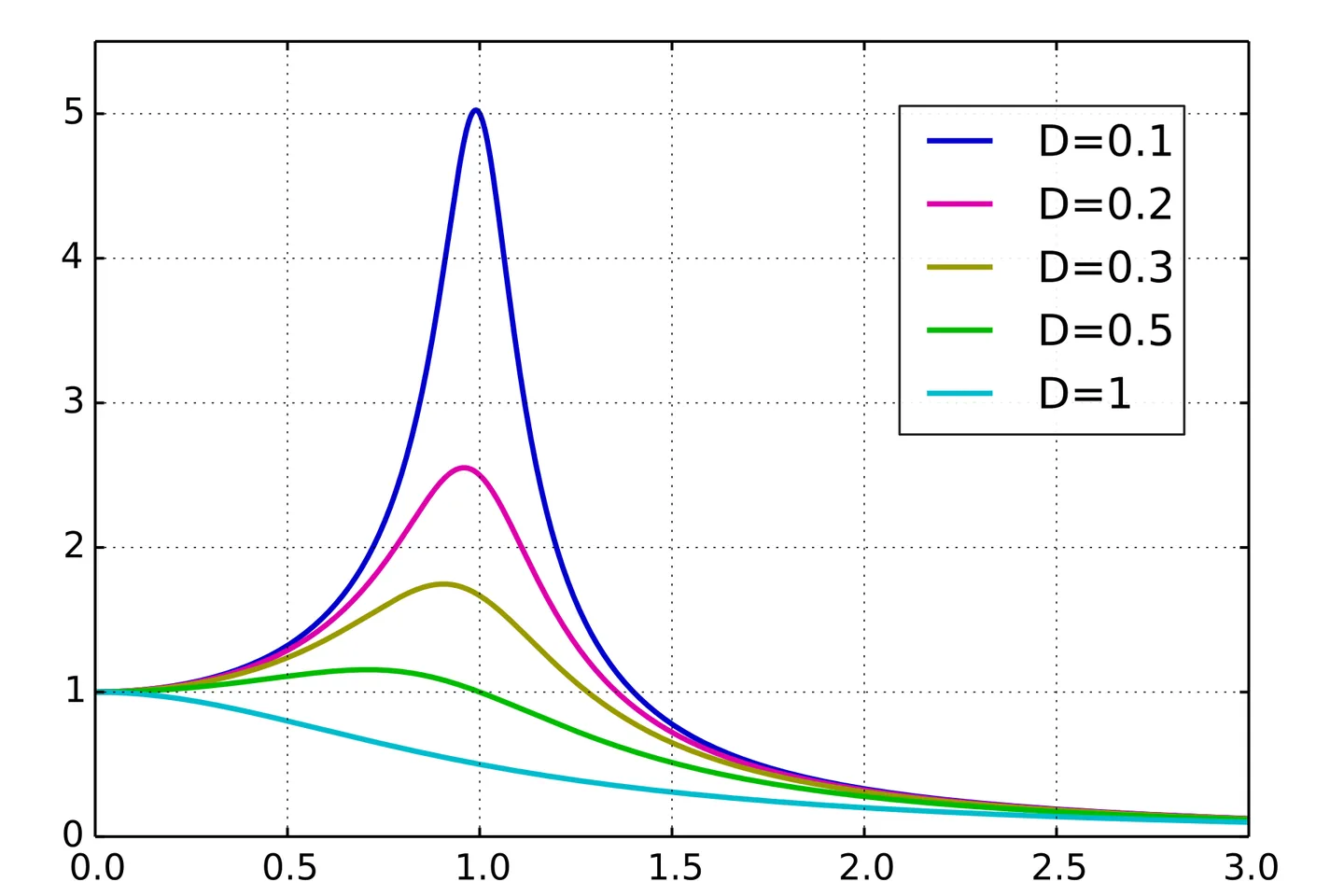
Image source:Geek3 · CC BY 3.0
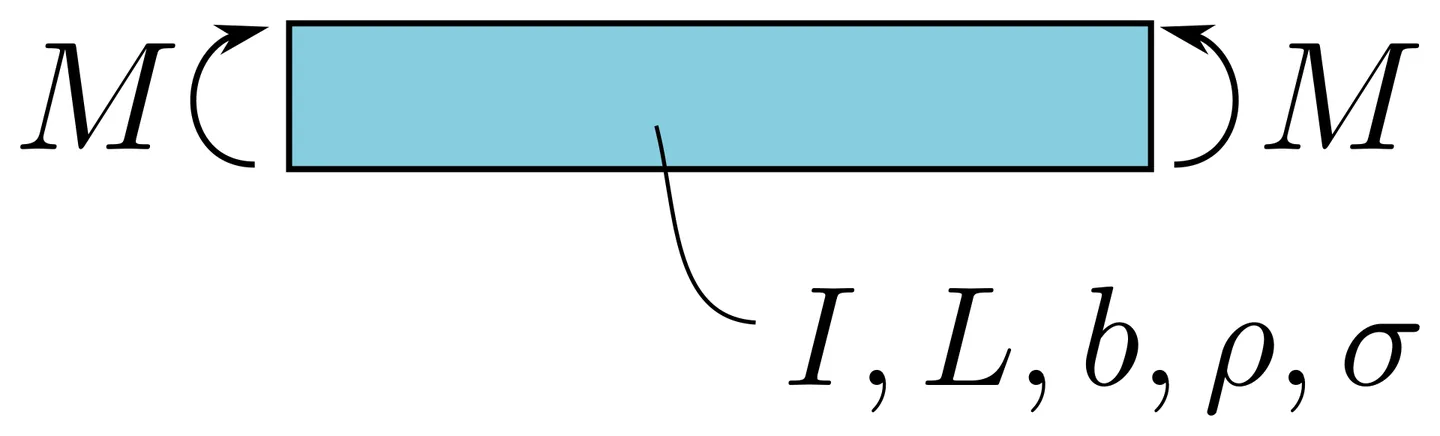
Image source:Nicoguaro · CC0
Higher modes often have more nodal lines, but order, frequency and shape must be defined for the actual structure, not borrowed directly from a regular plate. Opposite-phase regions affect interference; radiation also depends on spatial scale relative to wavelength and surface velocities. Higher modes are not necessarily weak radiators or irrelevant to loudness. Model truncation must follow the target band and measurements, not an assumption that everything above 1000 Hz is unimportant.
Modal superposition expresses response as a sum of contributions in a suitable linear model; decoupling into classical real modes also requires suitable damping conditions. Orthogonality is a mathematical relationship within a fixed model. It does not mean a brace or material change can independently tune one mode without affecting others. Structural changes commonly alter several frequencies, shapes and participation levels and require new measurements or calculations.
Here’s a look at damping, quality factor, and attenuation. Quality factor:
The Q of the string is determined by a combination of material internal friction, mechanical impedance matching to the bridge, and radiative coupling to the air/panel.
Typical mode shapes and their impact on timbre
Acoustic guitar has numerous modes distributed throughout the audible frequency range. The following selects several typical modes to illustrate their vibration shape characteristics and corresponding frequencies, as well as their contribution to the guitar’s tone.
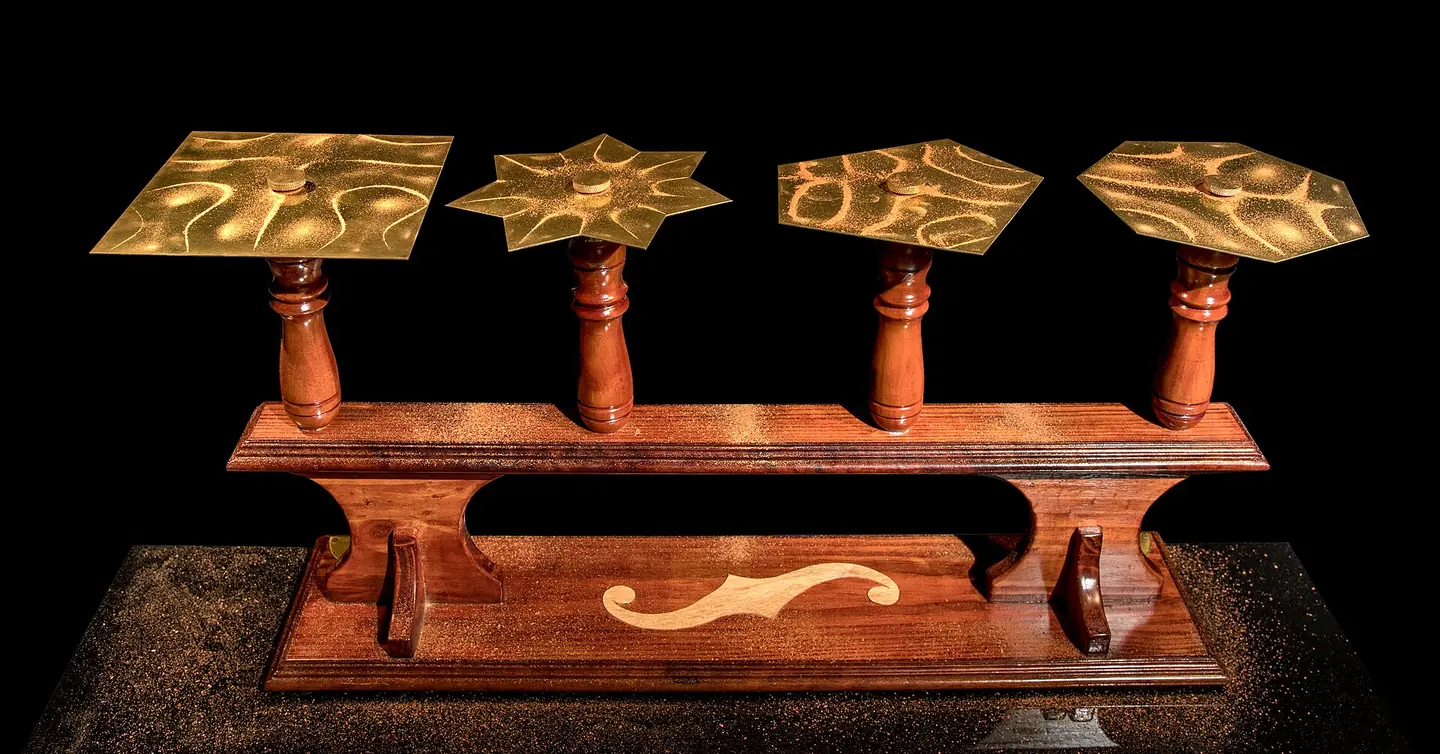
Image source:Rodrigo Tetsuo Argenton; exhibit: Estes Objethos Atelier · CC BY-SA 4.0

A low air-dominated resonance couples with the top and back; its frequency varies with cavity volume, soundhole and structure. 80–120 Hz is an example range for some guitars, near E2 (82.41 Hz) up to below B2 (123.47 Hz), not an acceptance specification. Airflow and plate phase depend on frequency, mode and the chosen positive directions, not a static breathing analogy. Resonance may improve radiation while increasing string energy loss; stronger bass does not guarantee longer sustain.
The main top mode has no fixed frequency independent of cavity and back. Coupling changes frequencies and shapes; some prominent structural resonances occur around 180–250 Hz, but comparison requires identified instruments, boundaries and excitation methods. A note such as G3 at 196 Hz is not a universal quality target, and unsourced 188/203 Hz values are not general results. Radiation also depends on surface velocities, phases and interference.
Higher modes often have more nodal lines, but order, frequency and shape must be defined for the actual structure, not borrowed directly from a regular plate. Opposite-phase regions affect interference; radiation also depends on spatial scale relative to wavelength and surface velocities. Higher modes are not necessarily weak radiators or irrelevant to loudness. Model truncation must follow the target band and measurements, not an assumption that everything above 1000 Hz is unimportant.
Generally speaking, modes of different orders contribute to the sound of the guitar: low-order modes (air cavity, main soundboard, etc.) determine the basic response curve and resonance characteristics of the sound, mid-order modes (mode shapes in the range of several hundred Hertz) enrich the timbre and projection of the mid-frequency band, and high-order modes give the sound unique overtones and texture. A well-designed guitar should have these modes well-distributed and staggered along the frequency axis to avoid having some pitches unsupported by resonance or having resonances that are too stacked at certain frequencies. Experienced luthiers will “tune” the soundboard and back plate during production so that their fundamental mode frequencies avoid the relationship of integer multiples of the musical sound, and at the same time disperse the higher-order mode frequencies, so that the guitar has a moderate resonance response to the notes all over the fretboard, and obtains a balanced and varied timbre.
Below we provide some mathematical explanations of the panel backplane and cavity.
The veneer is approximated as an isotropic thin plate (Kirchhoff–Love assumption), with thickness h, density ρ, Young’s modulus E, and Poisson’s ratio ν. Deflection w(x,y,t) satisfies:
D\nabla^4w+\rho_ph\frac{\partial^2w}{\partial t^2}

+\tau D\nabla^4\!\left(\frac{\partial w}{\partial t}\right)=p(x,y,t)
in:
D is the bending stiffness of the plate, eta is the structural loss factor, and p is the pressure difference on both sides of the plate. The boundary conditions are determined by the connections between the edging, the beams and the side panels; the actual panel with the bracing is a non-uniform anisotropic panel .
Modal superposition writing:
Among them:
M_k=\iint\rho_p h\phi_k^2\,dS,\quad K_k=\iint D[\phi_{k,xx}^2+\phi_{k,yy}^2+2\nu\phi_{k,xx}\phi_{k,yy}+2(1-\nu)\phi_{k,xy}^2]\,dS,\quad F_k=\iint p\phi_k\,dSThe Chladni pattern (sand method) actually shows the node lines (reflecting the constraint/beam layout).
For the cavity mode, the air in the cavity satisfies the following equation:
The sound hole of a guitar is similar to a short neck cavity, and the low-frequency main resonance (Helmholtz) frequency satisfies the following equation:
Changes in volume and sound hole position and depth will affect this frequency.
Then we consider the coupling. Taking the place where the bridge and the top are in contact as an example, the string end transverse velocity V a is continuous with the bridge/top speed V b. The force balance equation is:
in:
is the bridge point admittance (or mechanical sensitivity), the linear mode sum:
The equivalent damping at the string end is significantly affected by Y b: when ω approaches the panel mode, the energy is coupled out faster, that is, “some sounds are louder and shorter.”
Then we look at the coupling of the panel to the cavity air. Let the normal velocity field of the panel be V n(x,y,ω) , the cavity volume velocity U cav and the acoustic hole volume velocity U hole satisfy:
By combining the above equations, the classic two (or three) degrees of freedom coupling model can be obtained, and the low-frequency “mainboard mode”, “cavity mode”, “anti-phase/in-phase” synthetic mode frequency and radiation efficiency can be obtained.
Then we look at sound radiation and loudness. The perceived loudness of a guitar is related to the far-field sound pressure p∞. In the frequency domain, the normal velocity radiated sound power of the panel is approximately:
Among them, σ is the radiation efficiency (related to the wave number k=ω/c 0, plate wave phase velocity, and the matching degree of structural waves and air acoustic waves). The low frequency is mainly dominated by the piston component (overall volume velocity) and the acoustic hole jet; the medium and high frequencies are contributed by the high-order modes of the plate.
Experimental measurement and visualization of modal shapes
In order to further study and verify the above-mentioned guitar mode shapes, scientists and luthiers used a variety of experimental methods to visualize the vibration modes.
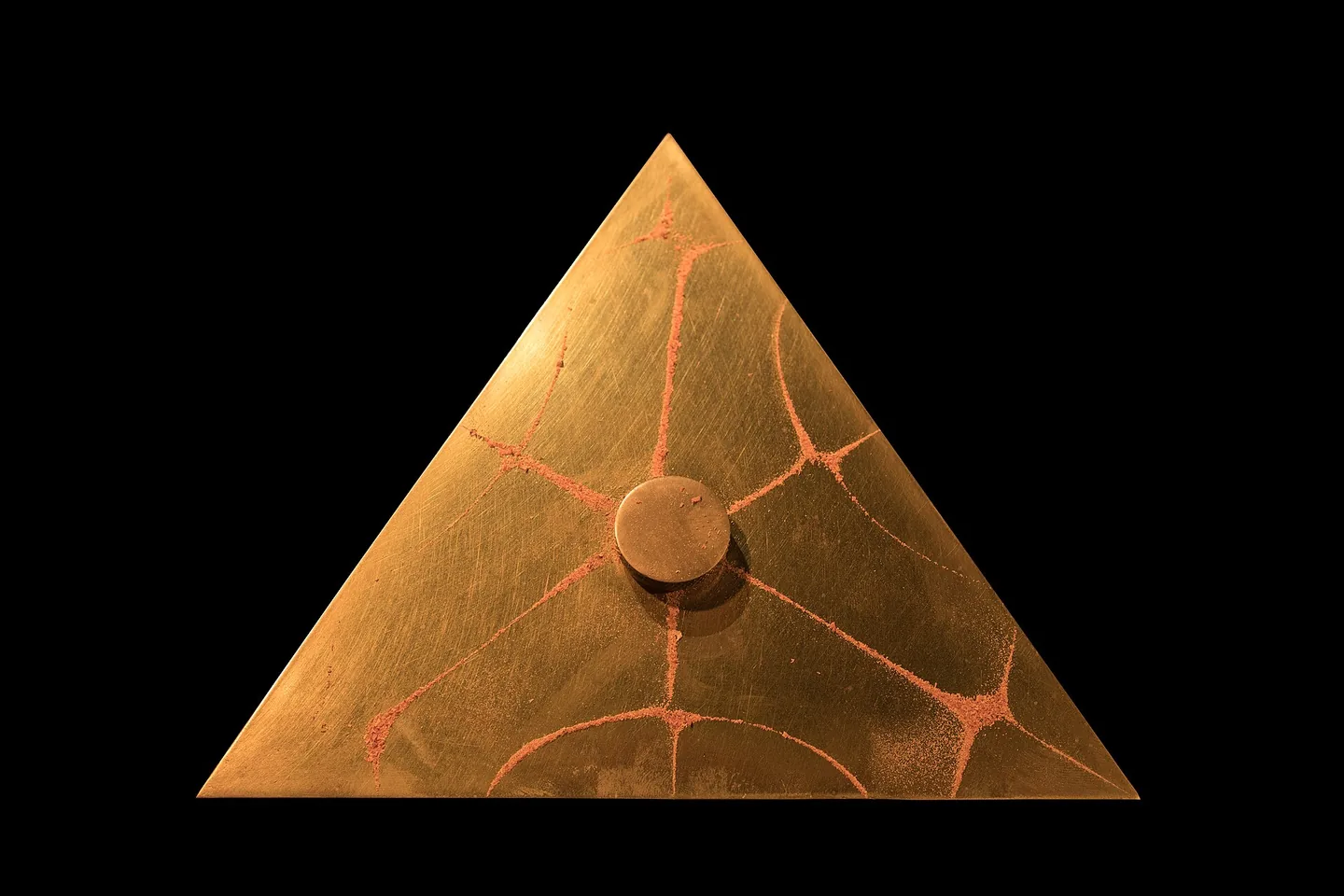
Image source:Rodrigo Tetsuo Argenton; exhibit: Estes Objethos Atelier · CC BY-SA 4.0
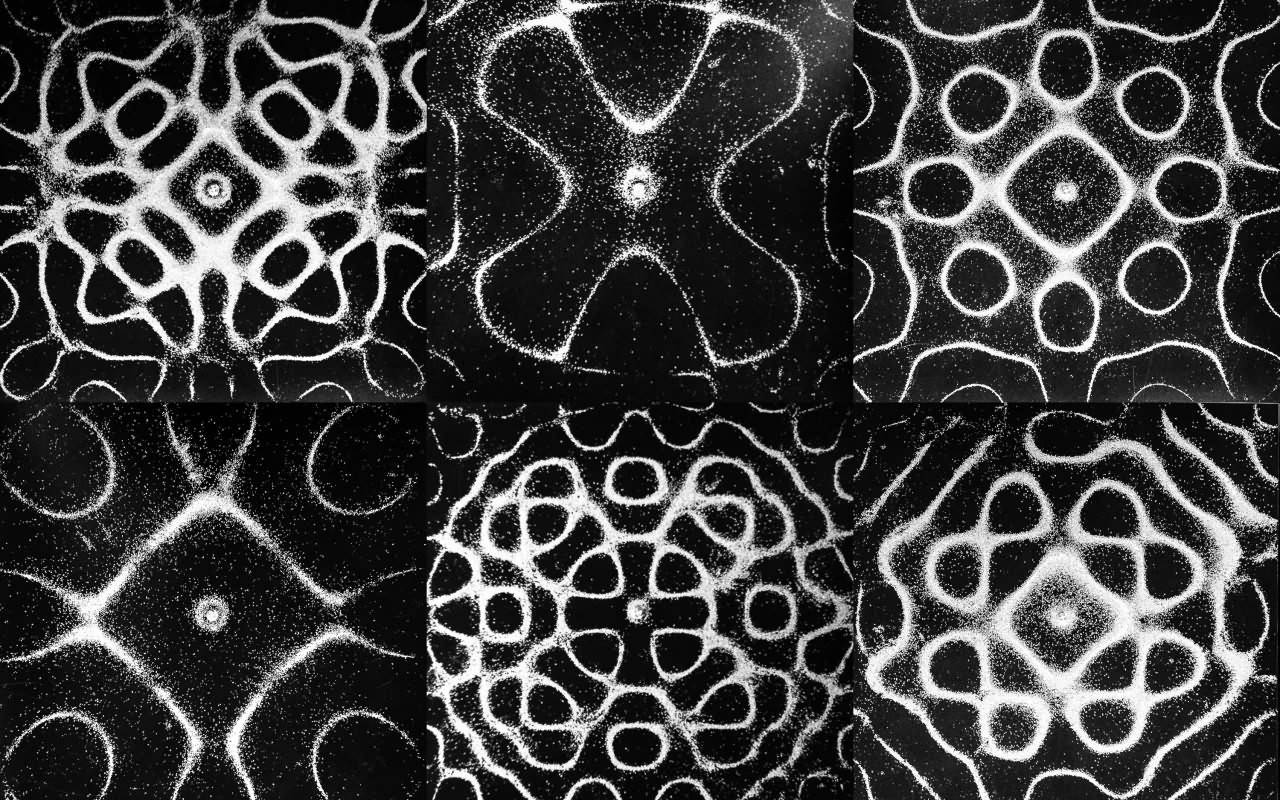
kradny board
- Chladny Method : The most classic in history is the Chladny Figure experiment. Sprinkle fine sand or tea leaves on the surface of the soundboard, and use a loudspeaker to sweep the frequency to excite the whole guitar or a separate soundboard. At certain frequencies (resonance frequencies), the vibration causes the sand grains to be shaken to the node lines, forming a visible vibration pattern. This method is simple to operate. As early as the 19th century, the physicist Chladni used it to observe the vibration shape of the plate, hence its name. For guitars, the Kladni method can measure the modal frequency and vibration shape of the soundboard and back plate before assembly. Luthiers use these patterns to judge the effect of soundboard thinning or bracing adjustments: a symmetrical soundboard produces a symmetrical pattern, and unusually asymmetrical node lines may indicate uneven material or structural asymmetry. It should be noted that the modal frequencies of the independent panel do not exactly correspond to the modal frequencies of the instrument assembled, but this method can provide useful feedback during the production process. The Chladny figure mainly shows the node topology of the modes, which is limited for quantitative research, but it has been proven to be very helpful in adjusting resonance in actual lutherie.
- Force hammer method : Record modal information through the acceleration sensor patch and excitation hammer
- Holographic Interferometry and ESPI: Laser holographic interferometry is another technology for high-precision visualization of vibrational shapes. By interferometrically measuring the subtle displacements of the vibrating surface, the hologram can display the equal displacement profile of the vibration in the form of a fringe pattern. Therefore, the spatial resolution is extremely high and complex vibration shapes can be clearly depicted. Electronic speckle interferometry (ESPI) is a digital implementation of holographic interferometry that also allows for real-time observation of vibrational modes. Researchers have used holographic interference to conduct modal measurements on musical instruments such as guitars, and the obtained vibration shapes correspond well to the finite element calculation results. For example, Chatziioannou et al. verified the accuracy of simulated modalities via ESPI on instruments such as double bass and viol. For guitars, similar methods can be used to observe the vibration patterns of the soundboard in various modes, including subtle local warping and phase differences, which are difficult to see directly with the naked eye. The advantage of holographic interference is that it can obtain continuous full-field information without placing points on the structure. It is currently one of the modal visualization methods with the strongest spatial resolution.
- Experimental modal analysis and acoustic-radiation measurement: In addition to observing mode shapes directly, researchers often combine impedance measurements with sound-field measurements. Mechanical admittance or impedance at the bridge can be measured by applying a unit force and recording vibration velocity, which reveals modal frequencies and damping. Microphone arrays can simultaneously map the radiated sound field and identify modes with high radiation efficiency. These measurements help determine which modes contribute most strongly to a guitar’s sound and guide design improvements.
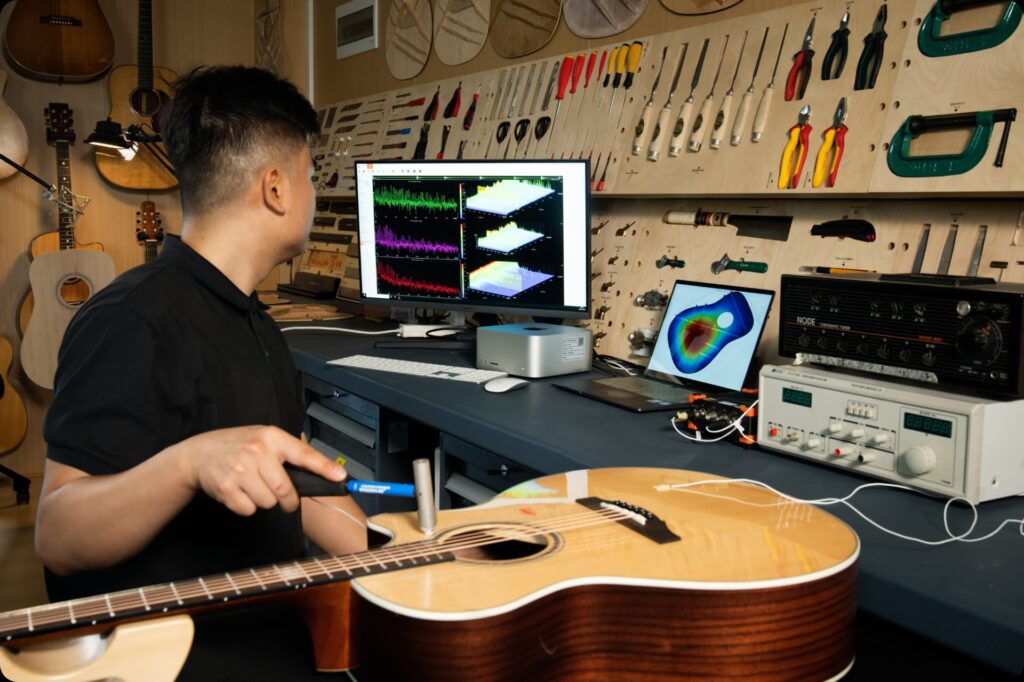
Modal testing
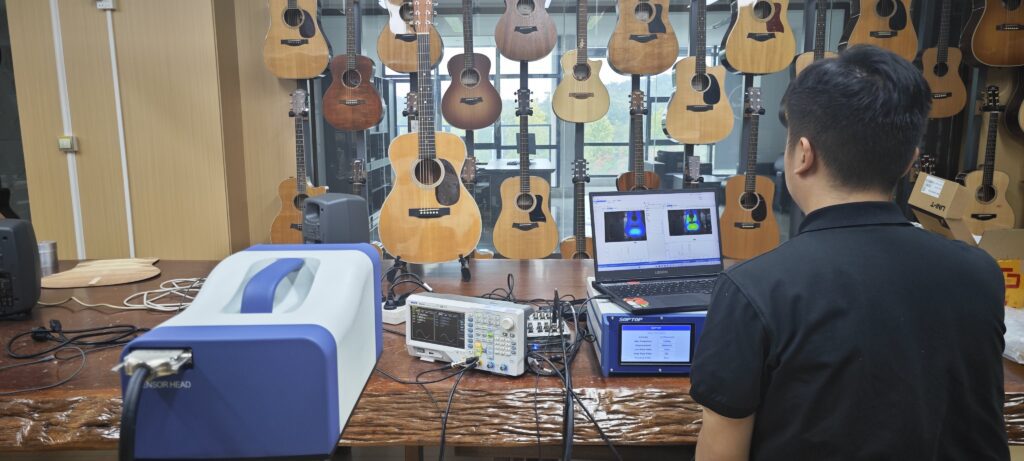
Modal testing
In summary, with the help of modern experimental techniques, we are able to “see” abstract modal shapes and connect theoretical models to real instrument behavior. These tools not only verify the existence and shape of each mode of the guitar mentioned above (for example, the measured breathing mode and soundboard mode of the guitar are very consistent with the calculated predictions), but also provide scientific basis for guitar manufacturing and improvement. Nowadays, in addition to empirical judgment, people are increasingly referring to modal test results to fine-tune musical instruments to make their frequency response more ideal. The secret of acoustic guitar timbre is contained in the rich and diverse mode shapes : Through theoretical modeling analysis and experimental visualization, we have deepened our understanding of how these modes vibrate in various frequency bands and couple with each other, and are closer to explaining the intertwined science and art problem of “why a good guitar sounds charming”.
This article is original content. Reprinting must be authorized by the author in advance, and the author and the source of the original text must be noted in a prominent position. No unauthorized modification of the content is allowed.
Formula conditions: ωₙ is the undamped natural angular frequency; ωd,n = ωₙ√(1−ζₙ²) is the underdamped free-vibration frequency (0 ≤ ζₙ < 1). Amplitude decays as exp(−ζₙωₙt); energy decays as its square. Q ≈ 1/(2ζₙ) and half-power bandwidth estimates apply to light, resolvable modes, not an arbitrary overlapping peak. The stiff-string approximation assumes uniform properties, constant tension and simply supported ends. Relative to its actual first mode, fₙ/f₁ = n√[(1+Bn²)/(1+B)]; the ideal flexible-string reference is not the stiffness-corrected f₁.
Sources and further reading
This interactive illustration mixes prescribed frequency ratios and sine patterns to explain nodes, antinodes and parameter scaling. It does not solve free circular-plate Bessel eigenvalues and is not a measured guitar mode. Colour represents illustrative displacement, not measured sound pressure. For a uniform isotropic thin plate, frequency also depends on thickness, radius, Poisson ratio and boundary conditions. Only with those fixed does f ∝ √(E/ρ) describe a scaling trend. Example values and patterns are not manufacturing acceptance data.
Kirchhoff–Love plate curvature energy · Kelvin–Voigt plate model

-10--scaled-e1787801713475-110x80.jpg)