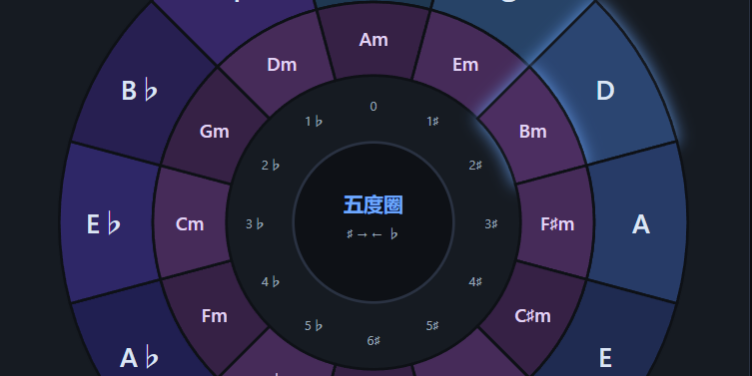
Kepma Circle of Fifths
The ultimate map for understanding keys, key signatures, chords and modulation. Click any key on the circle to hear and see its scale and chords, turning abstract theory into something you can touch.
Interactive circle
Outer ring = major keys, inner ring = relative minors. Neighbouring keys are aperfect fifthapart (clockwise), and their key signatures differ by only one sharp or flat. Click to try.
What exactly is the circle of fifths?
The circle of fifths arranges the 12 notes in a circle, each joined to the next by aperfect fifth. Starting from C, each step clockwise rises a perfect fifth:
C → G → D → A → E → B → F♯ → C♯ → A♭ → E♭ → B♭ → F → (back to C)
After 12 steps you return to the start, which is why it is a “circle”. This simple-looking arrangement encodes the most important rules of music theory in a single diagram.
① Why is the “fifth” so special?
The perfect fifth is the most consonant interval apart from the octave (frequency ratio 3:2). Moving by fifths changes onlyone noteof the scale at a time, so neighbouring keys are the most closely related and sound the most natural together. This is exactly the path modulations most often take.
② Key signature rule: sharps clockwise, flats anticlockwise
- Each step clockwise, the key signaturegains one sharp ♯(C = 0 → G = 1 → D = 2…)
- Each step anticlockwise, the key signaturegains one flat ♭(C = 0 → F = 1 → B♭ = 2…)
- The newly added sharp is the new key’sleading note(7th degree); the newly added flat is the new key’s 4th degree.
③ Mnemonics for sharps and flats
Order of sharps:Fa Do Sol Re La Mi Si
(F C G D A E B, which is the circle of fifths clockwise!)
The order of flats is exactly the reverse:Si Mi La Re Sol Do Fa
(B E A D G C F)
④ Enharmonic equivalents
At the bottom of the circle (6 o’clock), G♭ = F♯, D♭ = C♯ and C♭ = B. They sound the same but are written differently; which one to use depends on which spelling gives fewer accidentals and is easier to read.
⑤ Remember every key signature with one diagram
Go back to the first tab and click different keys: the right-hand panel shows each key’s signature, scale and chords in real time. This is the most practical use of the circle: fitting the signatures of all 15 major and 15 minor keys into your head at once.
💡 In one sentence
Circle of fifths = key-signature cheat sheet + chord-relationship map + modulation navigator, three in one. Once you can use it, composing, improvising, transcribing and harmonic analysis all get much faster.
Practical applications
The circle of fifths isn’t just for memorising key signatures: it’s a navigation tool for writing harmony. Here are its most common uses; click a progression to hear it.
Application 1: neighbours are harmonious, the “gravity” of chord progressions
Roots movinganticlockwise downthe circle (root down a fifth / up a fourth) are the strongest driving force in Western music, known as the “circle progression”. The famous ii–V–I is exactly two consecutive anticlockwise steps.
Application 2: find a song’s “natural chords”
For any major key, take its position on the outer ring: the major keysone step to the left and one step to the right, plus the three matching minor keys on the inner ring, cover almost every chord the song will use. For example, in C major:
F (IV)C (I)G (V) + Dm (ii)Am (vi)Em (iii) = 90% of the chords in pop songs
Application 3: find a “springboard” for modulation
- Closely related modulation: moving to a neighbouring key on the circle (e.g. C→G, C→F, C→Am) changes only one note, so the transition is the smoothest and listeners barely notice.
- Raising the key to lift emotion: pop choruses often jump clockwise near the end (up a whole tone ≈ two steps, or up a semitone), as in the key change at the end of Whitney Houston’s “I Will Always Love You”.
- Common-chord modulation: the closer two keys are on the circle, the more chords they share, and the easier it is to find a “pivot chord” as a springboard.
Application 4: memorising key signatures & fast transcription
Three sharps on the score? Count three steps clockwise = A major (or its relative minor, F♯ minor). Four flats? Count four steps anticlockwise = A♭ major. No more working it out one by one.
🎼 Practice tip
When practising scales with the circle of fifths every day, go clockwise (C-G-D-A…). This packs “fingering + key signature + sound” into memory together and is a standard foundation for classical and jazz players.
Classic examples
Example 1 · The Canon progression (Pachelbel’s Canon)
D major:I–V–vi–iii–IV–I–IV–V(D–A–Bm–F♯m–G–D–G–A). Notice the vi→iii→IV passage: the root keeps sliding along the circle, creating an endless “descending” feeling. That is the secret of its three centuries of popularity.
Example 2 · The pop “four-chord” 1–5–6–4
In C:C–G–Am–F. On the circle, all four chords sit within one step either side of C, which is why it sounds so smooth and catchy. “Let It Be”, “With or Without You”, “Boundless Oceans, Vast Skies” and countless other songs use it.
Example 3 · Jazz ii–V–I
In C:Dm7–G7–Cmaj7. The roots D→G→C are exactly two consecutive anticlockwise steps on the circle: the “atomic unit” of jazz harmony. Jazz players improvise by breaking a whole tune into a chain of ii–V–I’s.
Example 4 · The free-falling circle progression
Gloria Gaynor, “I Will Survive”:Am–Dm–G–C–F–B°–E–Am. The roots A→D→G→C→F→B→E→A go all the way round the circle! This “circular descent” gives the song its relentless forward drive.
Example 5 · The emotional burst of a key change
Michael Jackson’s “Man in the Mirror” and Beyoncé’s “Love On Top” (four key changes in a row!) shift the whole key clockwise as the chorus repeats, lifting the emotion a level each time. This is the most direct commercial use of the circle’s “distance = tension” principle.
How to analyse a song yourself
- Find the song’s key (read the key signature → locate it on the circle).
- Label the chords with degrees (I, ii, iii, IV, V, vi, vii°).
- Circle those chords on the wheel and see whether they “cluster” (pop) or “go round” (jazz/classical).
- Look out for any chord outside the circle: that is often where an exciting modulation or borrowed chord happens.
Text version of this page
Kepma Circle of Fifths
Kepma Circle of Fifths is an interactive music theory tool: the 12 keys are arranged in a circle by perfect fifths, with major keys on the outer ring and relative minors on the inner ring; neighbouring keys are a perfect fifth apart and differ by one sharp or flat. Click any key to see and hear its scale, tonic chord and I–IV–V–I cadence.
The 12 keys and their signatures
| C | Relative minor Am | Key signature: no sharps or flats |
|---|---|---|
| G | Relative minor Em | Key signature 1♯ (F♯) |
| D | Relative minor Bm | Key signature 2♯ (F♯ C♯) |
| A | Relative minor F♯m | Key signature 3♯ (F♯ C♯ G♯) |
| E | Relative minor C♯m | Key signature 4♯ (F♯ C♯ G♯ D♯) |
| B | Relative minor G♯m | Key signature 5♯ (+ A♯) (enharmonic C♭) |
| F♯ | Relative minor D♯m | Key signature 6♯ / 6♭ (enharmonic G♭) |
| D♭ | Relative minor B♭m | Key signature 5♭ (B E A D G) (enharmonic C♯) |
| A♭ | Relative minor Fm | Key signature 4♭ (B E A D) |
| E♭ | Relative minor Cm | Key signature 3♭ (B E A) |
| B♭ | Relative minor Gm | Key signature 2♭ (B E) |
| F | Relative minor Dm | Key signature 1♭ (B♭) |
Degree notation
I, ii, iii, IV, V, vi, vii°
Common chord progressions
- ii – V – I (jazz core): Dm7 → G7 → Cmaj7, roots D→G→C, two consecutive anticlockwise steps
- I – V – vi – IV (the pop all-rounder): C → G → Am → F, the backbone of countless pop hits
- I – vi – IV – V (the ’50s progression): C → Am → F → G, “Stand By Me” and more
- Circle progression (circular descent): Am→Dm→G→C→F, “I Will Survive” goes round the circle