Let’s first look at the relationship between the force required to press down a string and the string height (action).
A player’s playing feel is closely tied to the string height.
But at low string heights, a problem arises: the string’s effective vibrating region intersects the frets, causing fret buzz.
Without a solution, the only option is to raise the string height — but a high action is very hard to play…
When we pluck a string with a finger, the string is forced into vibration, producing harmonics in different combinations — which is where the different “timbres” come from.
So in what shape does a string actually vibrate? How does plucking at different positions change the harmonic mix? What changes when plucking with different media (fingertip, pick)?
How do different frequencies superpose?
All of these questions can be explored visually and aurally with Kepma’s self-developed, open-source tool below.
The actual vibration pattern of a string is complex. If the frets do not leave enough room for the string’s vibration, interference produces “fret buzz”.
When frets are dressed by hand, it is impossible to fine-tune every position of every fret, so fret buzz remains common.
We use the German PLEK machine for fret processing. With the string load pre-applied, the PLEK machine scans the entire fingerboard and frets with a precision of one thousandth of a millimetre, and levels every position of every fret according to the string vibration curve, minimising the risk of fret buzz.
At the same time, the nut slots are machined to extremely high precision, which ensures a great playing feel in the lower positions.
For more details about PLEK, please click here.
This article is original content. Reproduction requires the author’s prior authorisation, must prominently credit the author and the original source, and must not modify the content without permission.
About the tools embedded on this page: the pressing-force calculator and the string vibration visualiser
This page combines written explanation with two interactive tools, discussing the relationship between the force needed to press down a string and the string height, as well as the visualisation of the string’s complex vibration and sound synthesis.
Tool 1: Physical model and calculator of the total pressing force on a guitar
When barring all strings with a finger, the total force applied must overcome the restoring forces generated by the tension of all the strings. A simplified physical model can estimate this total force, giving an intuitive sense of why a higher action is harder to press down.
The parameters the calculator accepts are: the effective string length, in millimetres; the total string tension, in kilograms; and the string height at the 12th fret, in millimetres. After submission it returns the total force needed to bar all the strings, and plots how the total pressing force varies with the string height, making the relationship easy to observe. The page also provides an animated demonstration that simulates the process of a finger barring the strings.
Tool 2: String vibration visualisation and sound synthesis
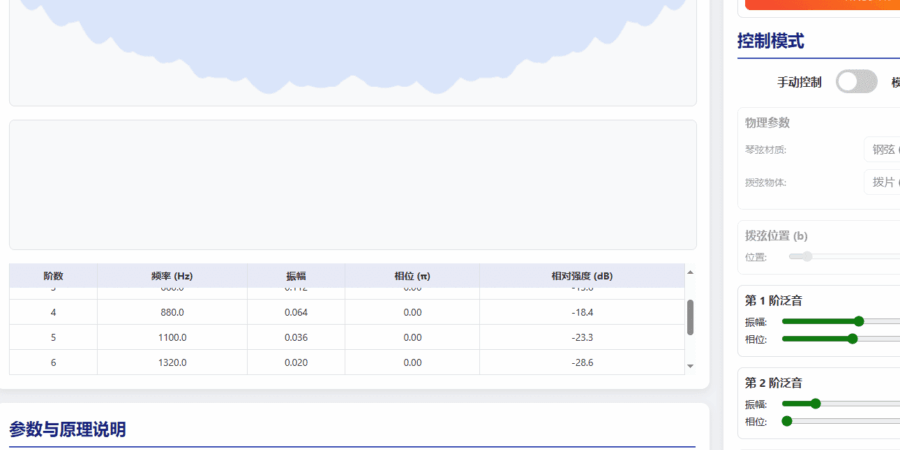
A string’s complex vibration can be decomposed into a linear superposition of simple normal modes — that is, harmonics — each with its own frequency, amplitude and phase. The tool lists the order, frequency, amplitude, phase and relative strength of each harmonic, and can play back the synthesised sound.
In simulated plucking mode, the amplitude of each harmonic is determined by several physical factors: the plucking-position factor, which determines which harmonics are excited depending on where the string is plucked — plucking at the node of a given harmonic suppresses that harmonic; the excitation factor, determined by the hardness of the plucking object — a hard object such as a pick excites more high-frequency harmonics for a brighter tone, while a soft object such as the fingertip suppresses them for a warmer tone; and the damping factor, determined by the string material — steel strings have low damping and retain more high-frequency harmonics for a crisp tone, while nylon strings damp quickly for a softer tone.
The tool supports both manual control and simulated plucking, with adjustable parameters including the string material, the plucking object and the plucking position, as well as the fundamental frequency and global parameters.
About the video
The page also embeds Kepma’s official video, which showcases the related products and craftsmanship. The video corroborates the physical model above: string height, tension and harmonic structure together determine a guitar’s playing feel and tonal character.


-10--scaled-e1787801713475-110x80.jpg)