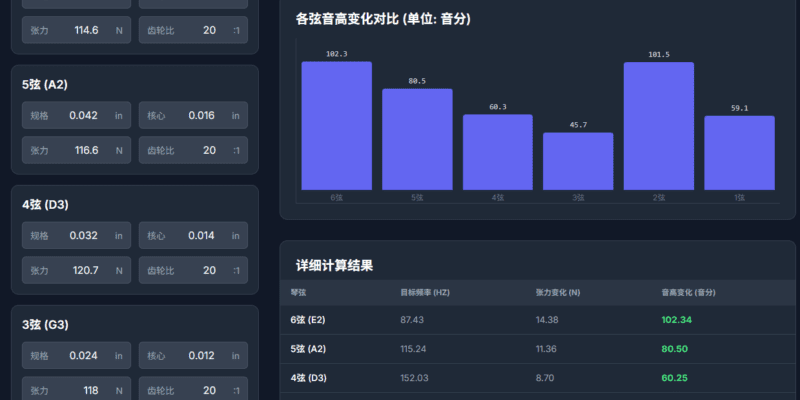
Most players have noticed this while tuning: turn the pegs of different strings by the same angle and the pitch changes by different amounts.
Some strings feel easy to tune “precisely”, while on others a tiny twist sends the pitch far off.
What is the principle behind this? Try it yourself with the mini tool below.
A tuning peg changes the string’s frequency by changing its tension.
Using twelve-tone equal temperament and the mathematics of cents, we can easily map the peg’s rotation angle to the change in pitch.
Modern guitar tuner design should also take tuning precision and practicality fully into account.
This article is original content. Reproduction requires the author’s prior permission, with the author and source clearly credited, and the content may not be altered.
Text version of this page
Tuning-Peg Rotation and Pitch Simulator · About the tool
This page embeds a tuning-peg simulator that shows the physical relationship between peg rotation and pitch change more intuitively. Turning a peg changes the string tension through the string post; the tension change alters the string’s vibration frequency, which you hear as the pitch rising or falling.
What the tool does
Drag the peg rotation angle to see how each string’s pitch changes. The tool accepts a rotation angle (the default example is 180 degrees), compares the pitch change of every string in cents, and lists the detailed results: each string’s new frequency, tension change and pitch change.
Adjustable parameters
String parameters can be set individually for each string. Global physical parameters include scale length, string-post radius, total string length and Young’s modulus, in metres and gigapascals respectively. Results update in real time as you change them, so you can compare how strings of different gauges respond to the same rotation.
Why different strings change pitch by different amounts
With the same post radius and rotation angle, thin and thick strings undergo different tension changes, and the effective vibrating length before and after winding also changes, so the same rotation produces a different change in cents. This is one reason why, in real tuning, a bass string changes noticeably with a tiny turn while a treble string needs to be turned further.
Relation to real-world tuning
Real tuning is also affected by nut friction, string age, the number of wraps and the post radius, so the simulation is an approximation under ideal conditions. Treat it as an aid for understanding the principle and developing a feel. When tuning, approach the target note from below: get close first, then fine-tune, rather than going back and forth across the target.
Further reading
To learn how string vibration and overtones are formed, see our String Vibration Visualiser and Sound Synthesis tool; to learn how pressing force relates to string action, see the Total Pressing-Force Physical Model and Calculator.