Introduction
The acoustic guitar is not only a widely loved musical instrument, but also a complex, multistage transducer. Its central function is to convert the high-impedance, low-amplitude mechanical energy produced by a plucked string into low-impedance, high-amplitude acoustic energy—sound waves that can radiate into the surrounding air. Acoustically modeling a guitar therefore requires us to examine the entire physical chain, from energy input to auditory perception.
This article begins with the vibrating string, the system’s most fundamental driving element and initial signal generator. It then examines the guitar body as a sophisticated mechanical filter and acoustic radiator that shapes and strengthens the raw string signal. From there, the guitar is treated as a coupled vibratory system comprising the strings, soundboard, back and sides, and enclosed air. We will consider how the dynamic interaction among these components produces the instrument’s distinctive resonances, quantify how the physical properties of tonewoods affect timbre, and finally move from physical acoustics into psychoacoustics to see how the human auditory system decodes objective vibrations as music rich in color and emotion. The aim is to provide a preliminary scientific model that makes the instrument easier to understand.
Part I: The Prime Mover—Physics of the Vibrating String
Within the guitar’s acoustic system, the string is the original input-signal source. Its modes of vibration determine the initial set of frequencies and their relative amplitudes. Every subsequent acoustic process modulates or filters this signal; in a linear time-invariant representation, this is essentially filtering—an EQ or convolution operation.
1.1 The Origin of Pitch: Wave Propagation and Reflection
When a guitar string is plucked, transverse waves containing many frequency components travel in both directions along it. On reaching the two fixed endpoints—the nut and saddle—the waves are reflected. Because the endpoints are fixed, each reflected wave undergoes a phase inversion. This inversion is essential to the formation of standing waves, since it ensures that displacement remains zero at the endpoints. The incident and reflected waves, identical in form but traveling in opposite directions, overlap and interfere.
1.2 Standing Waves and the Harmonic Series
In a standing wave, some points on the string remain stationary (nodes), while others reach maximum amplitude (antinodes), making the overall waveform appear stationary.
For a string of length $L$, a stable standing wave can form only when an integer number of half-wavelengths fits exactly into the string length:
This wavelength condition restricts the string to a discrete set of frequencies—the harmonic series:
– Fundamental ($n=1$): The lowest frequency, $f_1$, with $\lambda_1=2L$. The ear primarily interprets this fundamental as the note’s pitch.
– Harmonics or overtones ($n>1$): Higher-frequency vibrations whose frequencies are integer multiples of the fundamental, $f_n=n f_1$. They are generally not heard as separate pitches; instead, they blend with the fundamental to form the string’s characteristic timbre. Their presence and relative strengths distinguish a rich musical tone from a simple sine wave.
The string is therefore not an arbitrary vibrating body, but a quantized signal generator. Rather than random noise, it produces a harmonically rich signal with a strict mathematical structure. This structured signal is the basis for the body’s subsequent resonance and filtering, and is also a physical foundation of musical harmony.
1.3 The Pitch Equation: The Physics of Tuning
Frequency $f$ is determined by wave speed $v$ and wavelength $\lambda$ according to $f=v/\lambda$. Combining this relationship with the standing-wave condition gives the frequency of the $n$th harmonic:
The speed of a wave on a string is not fixed; it depends on the string tension $T$ and linear mass density $\mu$:
Substitution yields the complete ideal-string model:
This equation identifies every physical means by which players and makers control pitch:
- Changing length: Fretting a string shortens its effective vibrating length. The frequency rises, and so does the pitch.
- Changing tension: Turning a tuning machine changes $T$. Increasing tension increases wave speed and frequency.
- Changing linear density: The six strings differ in diameter and sometimes in material. A thicker bass string has greater $\mu$, so at the same effective length and tension its wave speed and fundamental frequency are lower.
Instrument design requires a trade-off among scale length, string material (which affects $\mu$), and the tension the structure can safely withstand. To obtain lower notes without making a string excessively slack or impractically long, its mass per unit length must be increased. This is why bass strings are thicker and are often made by winding metal wire around a core. Guitar making is thus not only an art, but also the practical solution of a multivariable physical equation.
1.4 The Initial Spectrum
The manner and position of plucking—the excitation mechanism—determine how the initial energy is distributed between the fundamental and the harmonics. Plucking near the middle of a string emphasizes the fundamental and produces a softer, fuller sound. Plucking close to the bridge excites more upper harmonics and produces a brighter or sharper sound. This collection of harmonic frequencies and initial amplitudes is the initial spectrum: the raw signal that the guitar body will process.
For a more detailed visualization of string vibration, see the related visualization linked in the original article.
Part II: The Acoustic Engine—The Guitar Body as Resonator and Radiator
The guitar body receives the strings’ vibrational energy and converts it into audible sound. It is not a passive box, but an active and complex acoustic filter and radiator that strongly shapes the final timbre.
2.1 The Soundboard: The Primary Vibrating Diaphragm
A string vibrating by itself has very little surface area and moves only a small amount of air, so it is barely audible. The top, or soundboard, is the most important component in sound production. Acting as a large diaphragm, it receives string energy through the saddle and bridge. Its broad surface can drive much more air and radiate sound far more efficiently than the string alone.
Top woods such as spruce and cedar are chosen for their high stiffness-to-weight ratios. They can vibrate efficiently while withstanding the strings’ large static load without excessive deformation.
2.2 Bracing and the Control of Vibrational Modes
Braces are wooden supports glued to the underside of the soundboard. They perform two crucial and often competing functions:
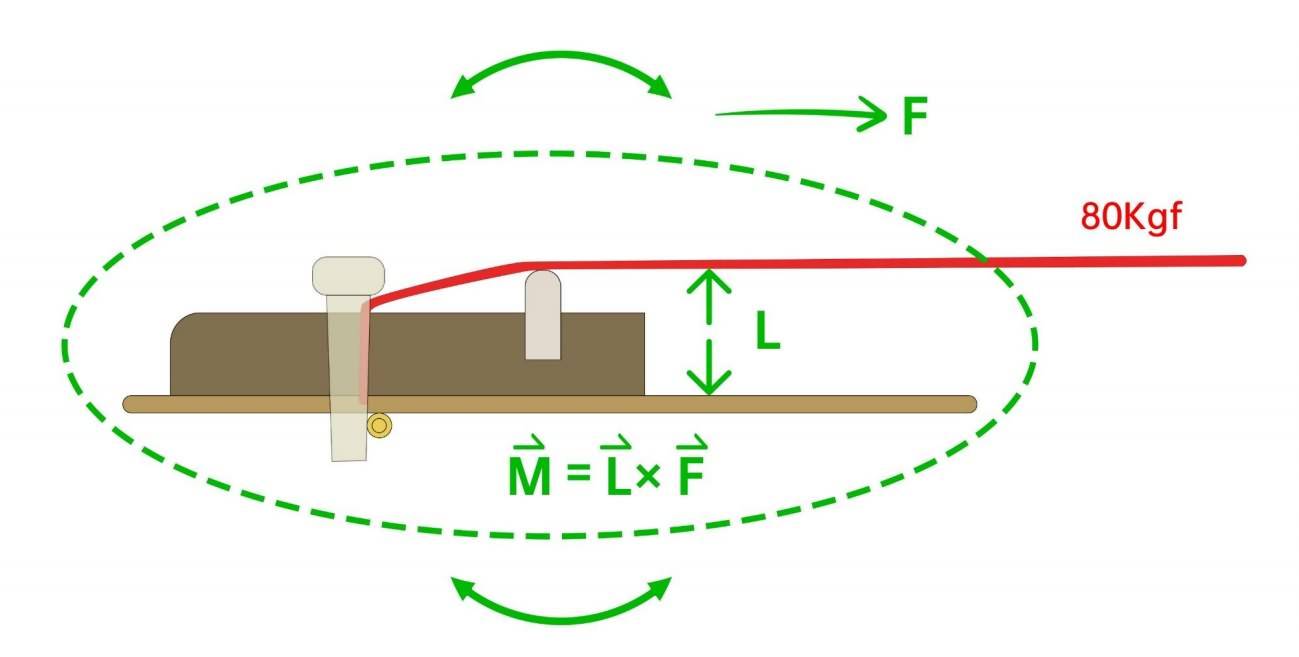
1. Structural support: The thin top must withstand a combined string tension that can reach approximately 80 kgf. The bracing provides the strength required to prevent collapse or excessive deformation.
2. Tonal shaping: Bracing patterns determine how the top vibrates. By increasing stiffness in selected areas, the braces control the shapes, locations, and frequencies of the soundboard’s modes. The maker seeks a balance between stiffness, which supports clarity and sustain, and flexibility, which supports volume and dynamic response.
The bracing system is therefore more than reinforcement; it functions like an acoustic circuit board, directing vibrational energy across the top and encouraging specific, musically useful patterns of motion. Different systems—X-bracing, fan bracing, V-Class, and others—can produce very different outputs from the same string input.
- X-bracing: The industry standard for steel-string acoustics. The crossed braces provide firm support beneath the bridge while allowing different regions of the top to vibrate. The design is known for balanced bass and treble response. Tone bars and finger braces further refine the modal balance.
- Fan bracing: Standard on classical nylon-string guitars. Lightweight braces radiate from below the soundhole. This flexible system suits the lower tension of nylon strings and effectively excites the top’s monopole, or breathing, motion, contributing to a warm and full classical-guitar tone.
- V-Class bracing: A modern Taylor design intended to control longitudinal stiffness along the centerline separately from transverse flexibility. It is claimed to use stiffness to enhance sustain, flexibility to increase volume, and more orderly vibration to improve intonation.
- K-bracing: A Kepma design developed through topology optimization and laser modal testing. It is intended to resist neck rotation and top bellying or collapse under string load while remaining lightweight and responsive to the player’s touch.


2.3 Visualizing Vibration: Chladni Patterns and Modes
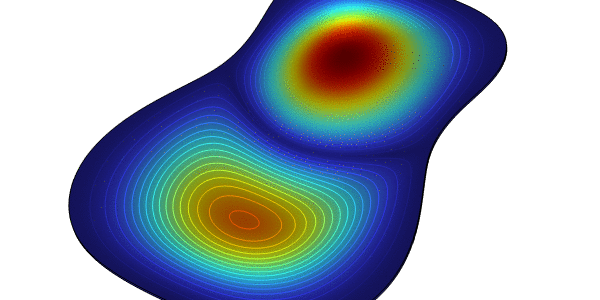
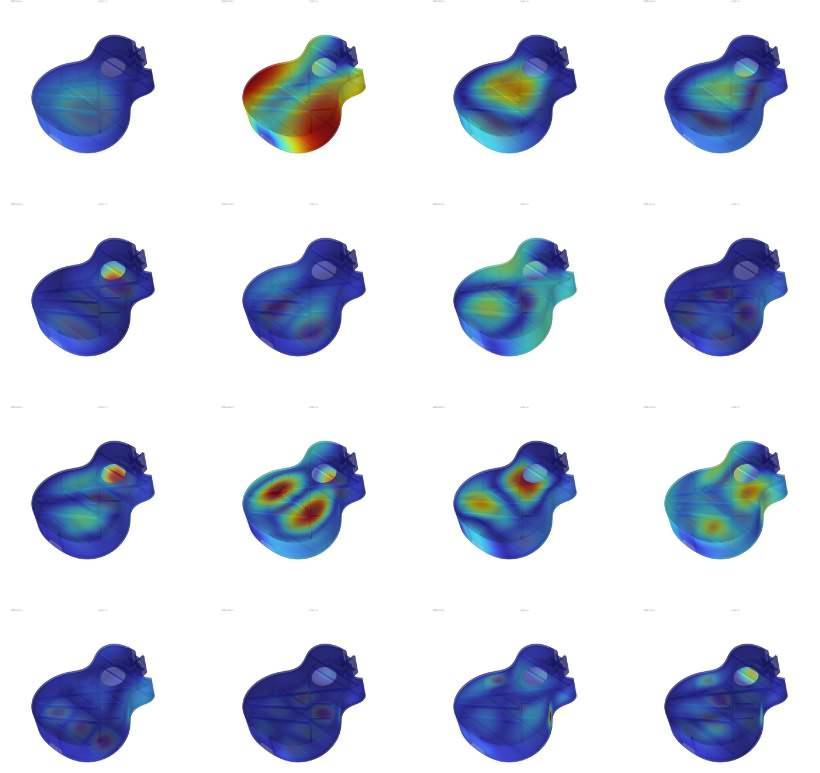
The soundboard’s complex motion at different resonance frequencies can be visualized with Chladni patterns. Fine sand is scattered over the plate, which is then driven at a selected frequency. Grains are thrown away from strongly moving antinodal regions and accumulate along stationary nodal lines, revealing the geometry of the mode—an early form of modal visualization.

Several important guitar-top modes are:
- Monopole mode: Also called the breathing mode. Most of the lower bout moves inward or outward in phase as one region. It is highly efficient at driving air and is critical to low-frequency response.
- Cross-dipole mode: The left and right sides of the lower bout move in opposite directions.
- Long-dipole mode: The upper and lower portions of the soundboard move in opposite directions.


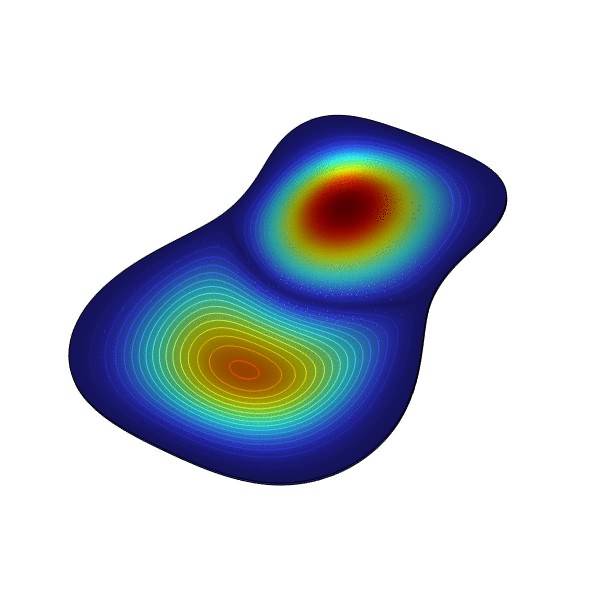
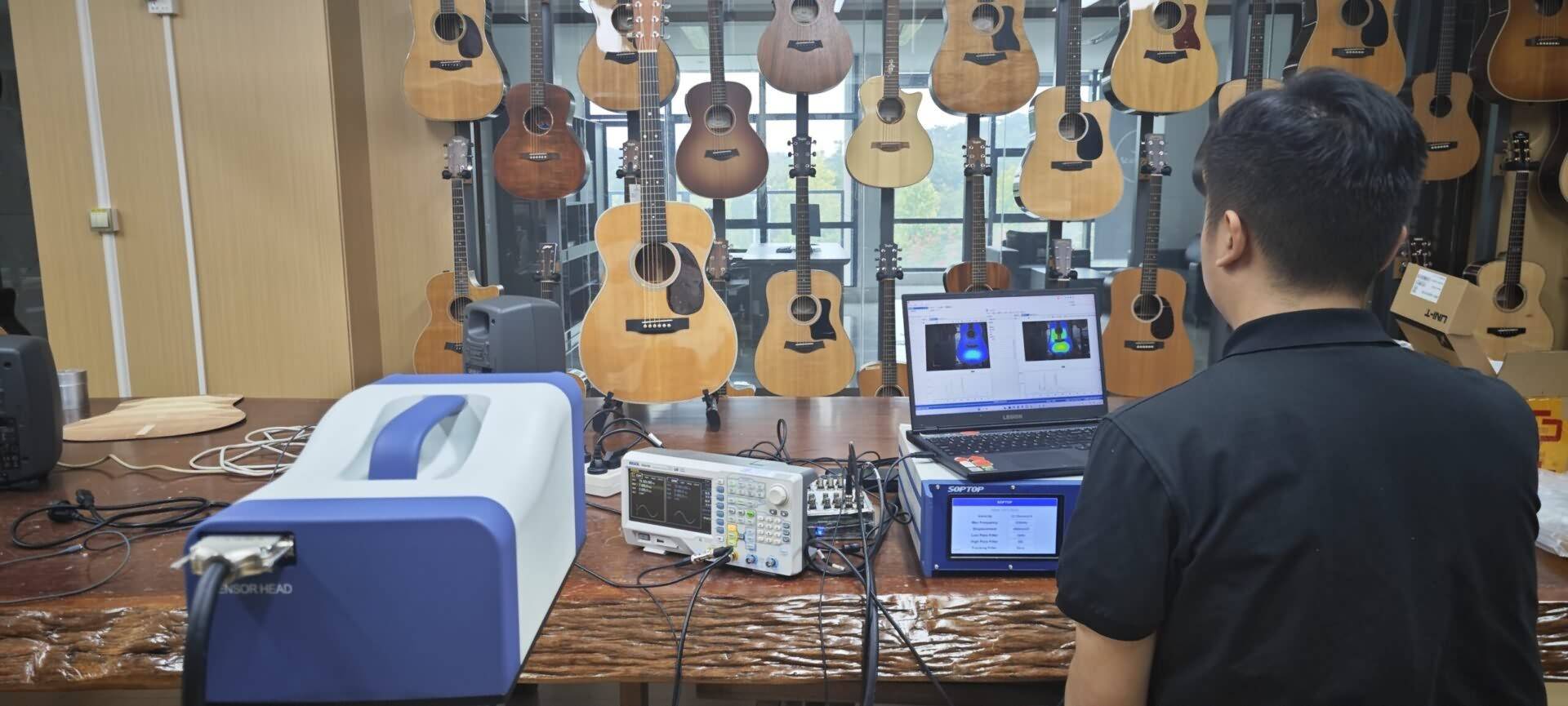
Modern engineering tools can now identify modal shapes and frequencies faster and more accurately.
2.4 The Air Cavity and Helmholtz Resonance
The air enclosed by the guitar body is itself a resonator, operating on the same principle as a bottle that sounds when air is blown across its mouth. This is Helmholtz resonance.
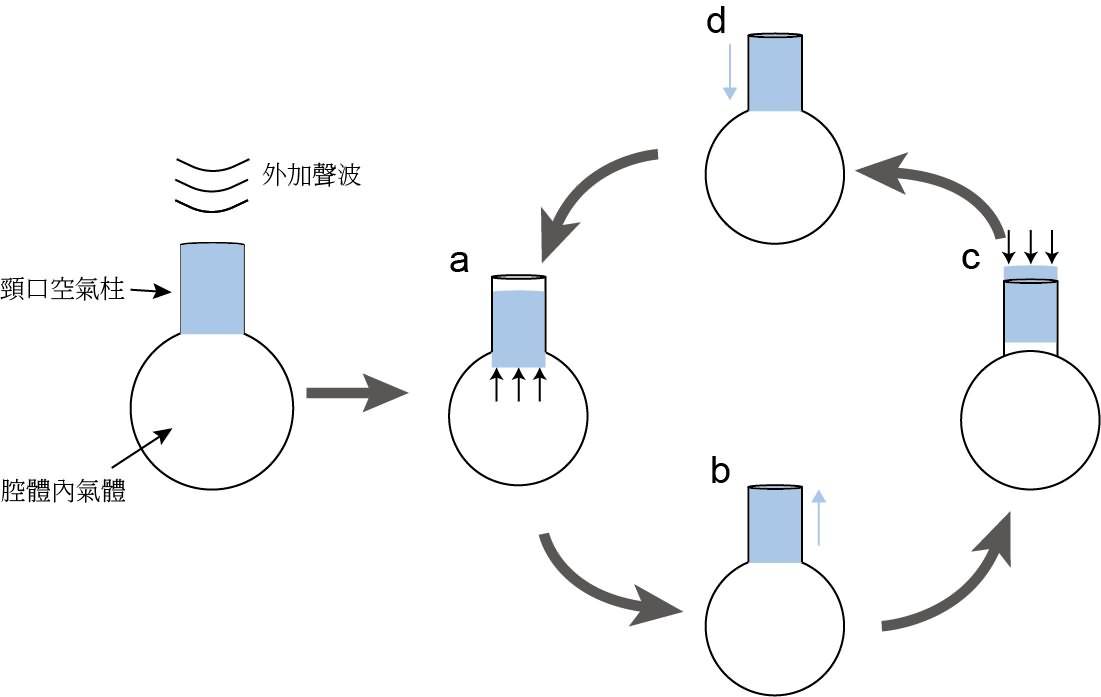
In the simplified model, the plug of air in the soundhole acts as a mass, while the large volume of compressible air inside the body acts as a spring. The natural resonance frequency is approximately
where $v$ is the speed of sound in air, $A$ is the area of the soundhole, $V$ is the body-cavity volume, and $L_{\mathrm{eff}}$ is the effective neck length of the soundhole, including end correction.
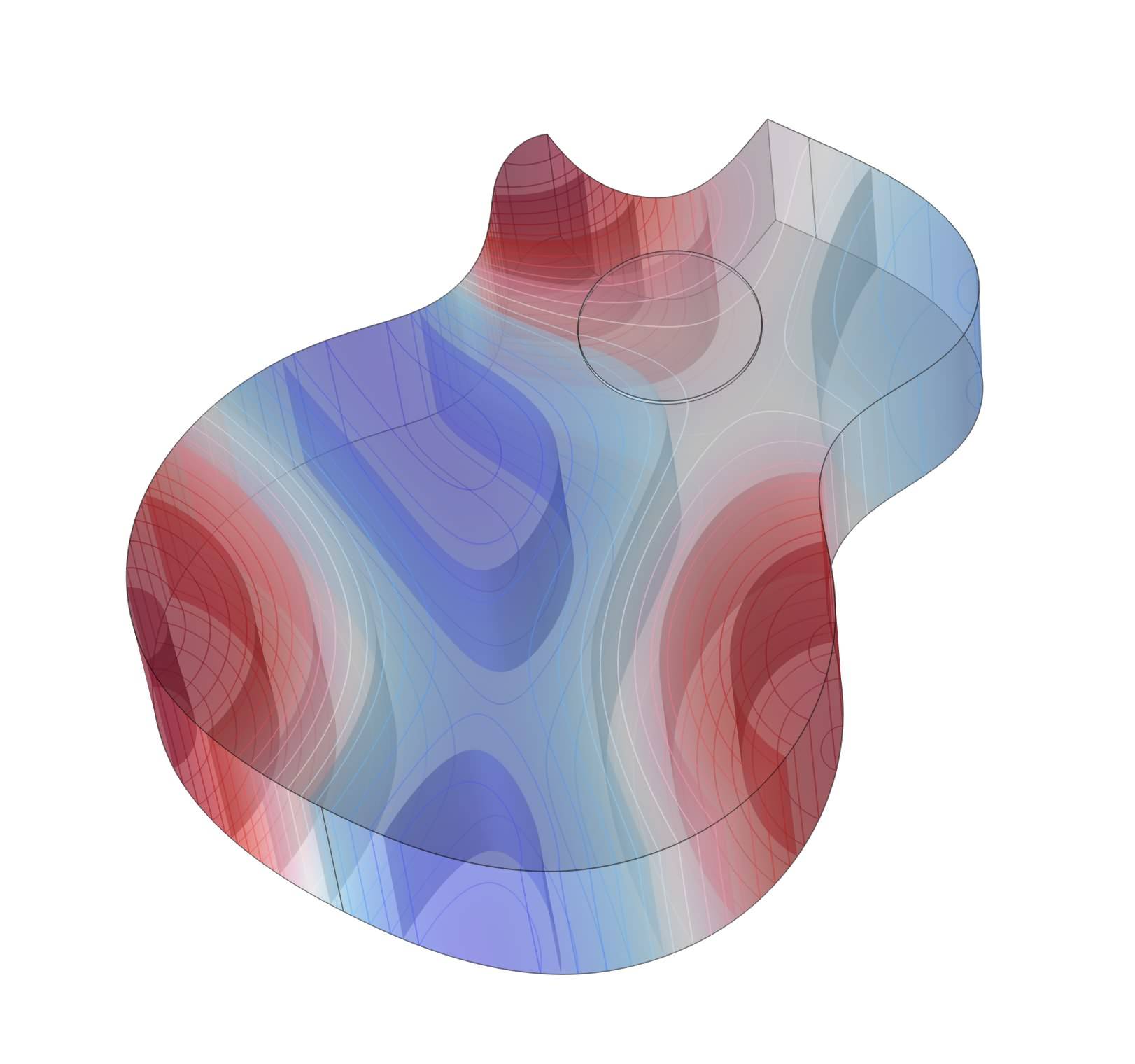
Helmholtz resonance produces a strong peak in the guitar’s low-frequency response, typically around 80–120 Hz (roughly G2 to B2), and contributes to a deep, powerful bass. At these frequencies, oscillatory airflow through the soundhole is an important sound source. Plucking any string can excite this resonance.
The low-frequency response is created by two distinct but tightly coupled mechanisms: the mechanical breathing of the soundboard (its monopole mode) and the pneumatic pumping of the cavity (Helmholtz resonance). The moving top drives the cavity resonance, and together they produce the characteristic fullness of an acoustic guitar’s bass.
2.5 The Role of the Back and Sides
Although the soundboard is the principal radiator, the back and sides are not inert. They respond through both cavity pressure and structural transmission through the body frame. The back has its own modes and couples with the top and cavity, especially at low frequencies. Depending on the coupled mode and on how the reference direction is defined, the top and back may move together or oppositely; these phase relationships significantly affect overall radiation efficiency and directivity.
Back-and-side woods such as mahogany and rosewood also color the sound produced by the top. A denser, more reflective wood such as rosewood can return more energy toward the soundboard and is associated with complex overtones and long sustain. Mahogany may attenuate some upper overtones, emphasizing the fundamental and yielding a warmer, more direct character.
This division of labor gives guitar sound a dual nature. Low frequencies are governed mainly by the soundboard’s global motion and cavity resonance, while high frequencies depend more on complex local motion near the bridge. Decisions affecting the whole body, such as cavity volume, therefore tend to alter bass response; local structural changes around the bridge, such as brace carving, tend to affect the treble more strongly.
Part III: The Integrated System—Coupling, Impedance, and Energy Transfer
3.1 The Guitar as a Coupled Vibratory System
At low frequencies, an acoustic guitar can be modeled as a coupled system of masses and springs. Its principal vibrating elements include:
1. Soundboard: An oscillator with characteristic mass and stiffness.
2. Back: A second mass–spring system; the sides are also important, though not developed further here.
3. Air cavity: The soundhole’s air plug supplies the mass, while the compressibility of the enclosed air supplies the spring in the Helmholtz model.
These oscillators do not operate independently. Movement of the top compresses the internal air, applying force to both the back and the soundhole air plug; movement of the back likewise changes cavity pressure. This mutual interaction is coupling.
Coupling combines the separate resonances of the top, back, and cavity into new normal modes of the entire system. The main air resonance and fundamental top resonance commonly split into two prominent low-frequency response peaks. In each mode, the phase relationships among top motion, back motion, and airflow determine radiation efficiency.
Experiments demonstrate this coupling clearly: partially blocking the soundhole changes the Helmholtz frequency and shifts both main low-frequency peaks. They are therefore not independent resonances, but products of the coupled system. The guitar’s characteristic sound is an emergent property of dynamic interaction, not a simple sum of sounds from isolated parts.
3.2 Impedance Matching and Energy Transfer
Impedance describes how strongly a medium or object resists motion under an applied force or sound pressure. The guitar contains a large impedance mismatch:
- String: High mechanical impedance—high tension, small motion, and relatively large force.
- Soundboard: Intermediate impedance—greater mass, but designed to remain compliant.
- Air: Very low acoustic impedance—easy to move, with little reaction force.
To produce sound efficiently, energy must pass from the high-impedance string to the low-impedance air; direct transfer would be very inefficient.
The bridge and top act as an impedance-matching transformer. The bridge receives the string’s high-force, low-displacement vibration and converts it into the lower-force, larger-displacement motion needed to drive the soundboard. The top’s large area then couples this motion efficiently to the air, much like a mechanical lever transferring energy between systems with very different properties.
Energy-transfer efficiency determines the trade-off between sustain and volume:
- Greater impedance mismatch (for example, a heavy bridge or top): More energy is reflected back into the string, producing longer sustain but a lower initial volume.
- Smaller impedance mismatch (for example, a light bridge or top): Energy reaches the soundboard more quickly, producing a louder attack but consuming the string’s energy faster and shortening sustain.
The bridge is therefore not merely an anchor. It functions like a transmission, regulating the flow of energy from the string to the soundboard through its mass, stiffness, and contact area. Small design changes can profoundly alter dynamic response and timbre.
3.3 The Complete Vibration and Radiation Chain
The sound-production process can be summarized as follows:
1. Excitation: The player plucks a string, establishing a standing wave with a particular fundamental and initial harmonic spectrum.
2. Transmission: String vibration applies forces and moments to the saddle and bridge, producing rocking and torsional motion.
3. Transduction and filtering: The bridge drives the top. The soundboard and bracing respond in their natural modes, mechanically filtering the string signal—amplifying components near resonances and attenuating others.
4. System coupling: Top motion couples to the air cavity and back, exciting the system’s coupled resonances, including Helmholtz and body modes.
5. Radiation: Sound reaches the surrounding air from several sources:
- the vibrating soundboard, the main source especially at mid and high frequencies;
- the oscillating air at the soundhole, a major low-frequency source driven by Helmholtz resonance;
- the vibrating back, which also contributes to the total sound field.
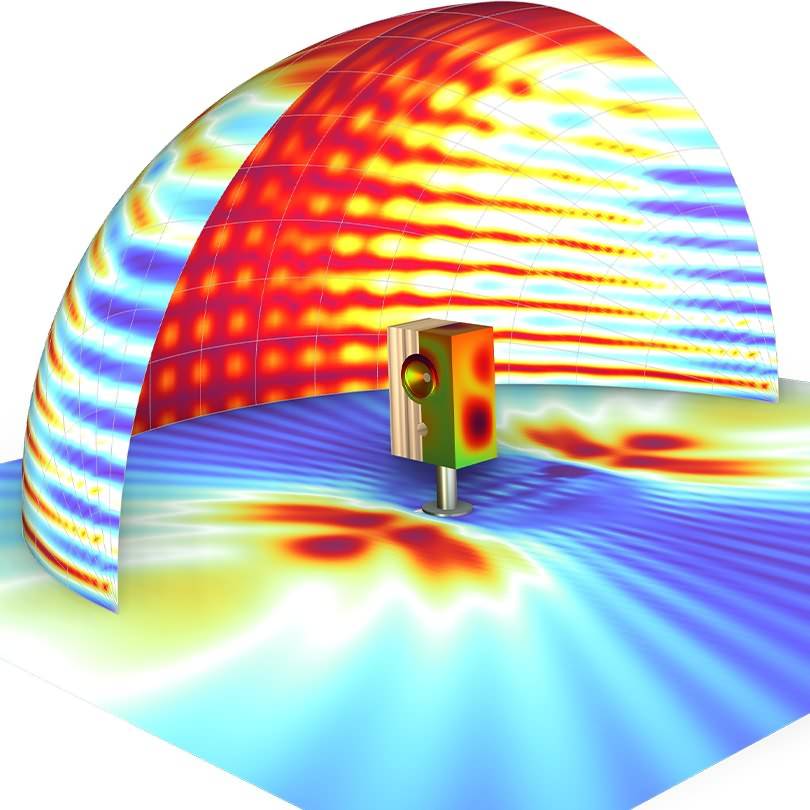
Because different regions can move with different phases—for example, the upper top moving outward while the lower top moves inward—their radiated waves interfere in space. The guitar’s sound field is therefore anisotropic: level and timbre vary with listening direction and distance.
Part IV: Material Effects—The Science of Tonewood
4.1 Key Physical Parameters of Tonewood
The acoustic behavior of wood is governed chiefly by several mechanical properties:
- Density ($\rho$): Mass per unit volume, in $\mathrm{kg/m^3}$. Lower-density woods are often favored for tops because they are easier to drive.
- Young’s modulus ($E$): A measure of stiffness, or resistance to bending. A high modulus allows a top to be made thinner and lighter while retaining enough stiffness to transmit vibration and withstand string tension. The speed of sound in wood is proportional to $\sqrt{E/\rho}$.
- Internal damping (loss factor $\tan\delta$): The rate at which wood dissipates vibrational energy as heat. Low damping permits longer vibration and supports sustain and resonance; high damping can make the sound seem muted.
- Acoustic radiation coefficient ($R$): A composite index commonly defined as
It indicates how efficiently a material can convert vibrational energy into acoustic energy. A high value is desirable for a soundboard.
Tonewood selection is a multiparameter optimization problem. There is no single best wood; the maker seeks the best combination of density, stiffness, damping, hardness, and stability for each component. An excellent top wood may be too soft for a fingerboard, and vice versa. Lutherie is therefore also a form of precision materials engineering.
4.2 Comparative Analysis of Common Tonewoods
Tops generally use softwoods with high stiffness-to-weight ratios.
- Spruce: The industry standard, offering a very high stiffness-to-weight ratio and a powerful, clear sound with wide dynamic range. Sitka spruce has a typical density of about $425\,\mathrm{kg/m^3}$ and a longitudinal modulus of approximately $11\,\mathrm{GPa}$.
- Cedar: Usually less dense and less stiff than spruce. Western red cedar, for example, has a density of about $370\,\mathrm{kg/m^3}$ and a modulus near $7.7\,\mathrm{GPa}$. It responds readily to a light touch, but may compress under forceful playing. Its tone is often described as warm and rich in overtones.
Backs and sides generally use dense, stiff, reflective hardwoods.
- Mahogany: A medium-density wood known for a strong fundamental, clear midrange, and direct, woody character. It tends to attenuate some upper harmonics, making the sound less overtone-rich than rosewood.
- Rosewood: A very dense, hard, and resonant wood. Its density and relatively low damping are associated with complex overtones, long sustain, and a scooped or extended tonal profile with strong lows and highs.
Necks and fingerboards are selected for hardness, density, wear resistance, and stability under string tension. Mahogany and maple are common neck woods; ebony and rosewood are widely used for fingerboards because of their hardness, density, and smooth feel.
4.3 Typical Acoustic and Mechanical Properties of Tonewoods
| Wood | Typical use | Density ρ (kg/m³) | Longitudinal modulus E (GPa) | Janka hardness (N) | Radiation coefficient R | Principal tonal association |
|---|---|---|---|---|---|---|
| Sitka spruce | Top | 425 | 11.0 | 2,270 | 12.0 | Powerful, clear, wide dynamic range |
| Western red cedar | Top | 370 | 7.7 | 1,560 | 12.3 | Warm, responsive, overtone-rich |
| Mahogany | Back, sides, neck | 540–640 | ~10.0 | ~4,000 | ~8.0 | Strong fundamental, warm and woody midrange |
| Indian rosewood | Back, sides, fingerboard | ~830 | ~12.0 | ~11,000 | Low | Complex overtones, powerful lows and highs |
| Maple | Back, sides, neck | ~705 | 12.6 | 6,450 | Low | Bright, focused, transparent |
| Ebony | Fingerboard, bridge | ~960 | ~16.0 | ~13,700 | Low | Clear attack, long sustain |
4.4 Anisotropy: The Directionality of Wood
Wood is anisotropic: its properties differ in the longitudinal, radial, and tangential directions. Stiffness and strength are far greater along the grain than across it, and sound also travels much faster along the grain.

Makers take advantage of this by using quarter-sawn wood for soundboards, normally orienting the grain parallel to the strings. This maximizes longitudinal stiffness and helps vibrational energy travel rapidly and efficiently from the bridge across the top, supporting responsiveness and volume.
Part V: From Physical Waves to Auditory Perception—The Psychoacoustics of Guitar Tone
5.1 Timbre: The Identity of a Sound
Timbre is the perceptual quality that allows listeners to distinguish two sounds having the same pitch, loudness, and duration. It is often described as a sound’s color or texture.
Although timbre is multidimensional, its physical basis is governed mainly by two features:
1. Spectral envelope: The distribution of energy across the harmonic series. The number and relative amplitude of the harmonics determine the spectrum’s shape. A sound rich in upper harmonics is perceived very differently from one dominated by the fundamental.
2. Temporal envelope (ADSR): The change in amplitude over time, including attack, decay, sustain, and release. The attack transient is especially important for identifying an instrument. If the attack is removed from a recording, many instruments become difficult to recognize.
Timbre is therefore not merely a static collection of harmonics; it is a dynamic acoustic fingerprint. The complex and often noisy onset of a note contains a great deal of information used by the brain to identify its source—sometimes more than the steady portion of the sound. This explains why synthesized sounds can seem artificial when they reproduce the harmonic spectrum but fail to model the attack accurately.
5.2 The Physical Basis of “Warm” and “Bright”
Common subjective terms in music and audio correspond to particular spectral features:
- Brightness: Associated with a greater proportion of energy in the upper-mid and high-frequency ranges, for example above 4–6 kHz. A bright sound has a higher spectral centroid, prominent upper harmonics, and may be described as clear, crisp, or brilliant. Plucking close to the bridge produces this effect.
- Warmth: Associated with a strong fundamental and abundant low-mid energy, for example around 200–500 Hz, together with relatively subdued high frequencies. Warm sounds are often described as smooth, full, or rounded. Rosewood backs and sides are often said to contribute warmth, partly because they can support a complex low-frequency overtone structure.
These apparently poetic terms are shared perceptual labels for objective physical features. Brightness reliably describes a high spectral centroid, while warmth denotes ample energy in the low and middle frequencies. This correspondence lets the experiential language of makers and musicians be analyzed and communicated in physical and engineering terms.
5.3 Timbre Space: Mapping Perception
Psychoacoustic research uses methods such as multidimensional scaling (MDS) to construct a timbre space. Participants rate the similarity of different instrumental sounds, and an algorithm represents those sounds as points in a multidimensional space. Distances between the points correspond to perceived differences.
The dimensions represent the features most salient to human timbre perception. Research consistently links them to quantities including:
1. Spectral centroid (brightness): The primary dimension separating dark from bright sounds.
2. Attack time: Separates sounds with sharp, percussive onsets, such as a plucked guitar, from sounds with gentle onsets, such as a bowed violin.
3. Spectral irregularity or flux: Describes the amount of noise in the spectrum and the extent to which the spectrum changes over time.

Conclusion
This article has partially dissected the acoustic guitar; within the available space, topics such as detailed side behavior, modal testing, quality factor, and broader psychoacoustics could not be developed fully. The discussion nevertheless reveals the guitar as a work of sophisticated physical engineering. Its final sound is an emergent property of a highly interconnected system in which every parameter matters: the harmonic series produced by the string; engineered modal filtering by the braced soundboard; low-frequency reinforcement from Helmholtz resonance; impedance matching by the bridge; the material properties of tonewoods; and the time–frequency pattern ultimately decoded by the brain as timbre.
An acoustic model of the guitar is therefore not a single-equation problem. It is a multidisciplinary coupled-system problem involving mechanics, materials science, fluid dynamics, acoustics, and human perception. A deeper understanding of these principles not only explains the behavior of existing instruments, but also provides a scientific foundation for future design and innovation.
This article is original content. Reproduction requires the author’s prior authorization. The author and the original source must be credited prominently, and the content may not be modified without permission.